Tesla's profit plunge: EV slowdown meets AI spending spree
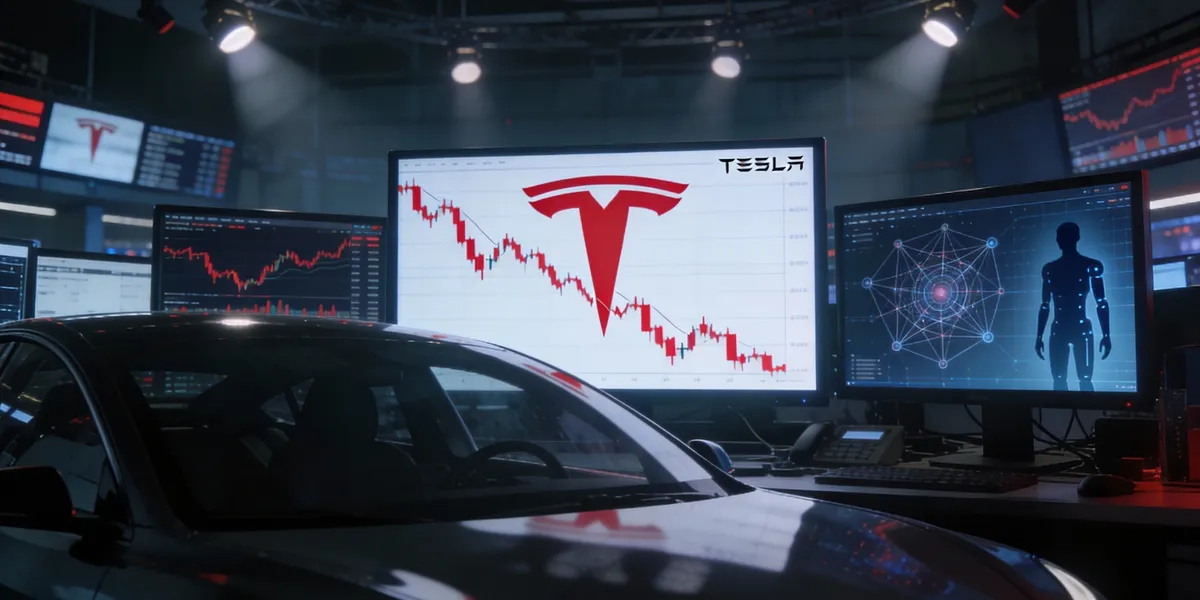
Tesla investors woke to sobering news as the electric vehicle pioneer reported a 61% plunge in quarterly profits, revealing the sharp collision between slowing car sales and Elon Musk's expensive artificial intelligence ambitions. The company's net income tumbled to just 840 million dollars in the fourth quarter, down from 2.15 billion dollars a year earlier, whilst revenue slipped 3% to 24.9 billion dollars.

For retail investors who've watched Tesla shares multiply over the past five years, this stark profit decline signals a fundamental shift in the company's trajectory—one that forces a reckoning between Musk's vision of an AI-powered future and the immediate challenges of selling cars in an increasingly competitive market.
The earnings report arrives at a pivotal moment for Tesla, which has dominated the electric vehicle conversation for more than a decade but now faces mounting pressure from traditional automakers and Chinese competitors flooding the market with more affordable options. Operating expenses surged at the Austin-based manufacturer, driven largely by massive investments in artificial intelligence infrastructure, including computing power for Tesla's Full Self-Driving technology and the humanoid Optimus robot project. Meanwhile, the company's core business—selling electric vehicles—encountered headwinds as high interest rates dampened consumer appetite for expensive purchases and price cuts eroded profit margins. Tesla delivered approximately 1.79 million vehicles globally in 2025, falling short of the 2 million-unit milestone analysts had anticipated and representing only modest growth from the previous year.

When AI investment collides with automotive reality
The dramatic profit squeeze exposes the tension at the heart of Tesla's current strategy. Whilst Musk has pivoted towards positioning Tesla as an artificial intelligence and robotics company rather than merely an automaker, investors still depend on vehicle sales to generate the cash flow that funds these futuristic ventures. The fourth quarter results demonstrated how difficult it becomes to maintain profitability when simultaneously fighting a price war in the automotive sector and pouring resources into speculative technology projects. Tesla's operating margin compressed to roughly 8%, down from the comfortable double-digit margins the company enjoyed during its pandemic-era boom when demand far exceeded supply, and the company could command premium pricing.
The AI spending spree encompasses several ambitious projects that Musk believes will define Tesla's long-term value. The company has accelerated development of its Full Self-Driving software, invested heavily in custom AI chips and supercomputers, and advanced work on the Optimus humanoid robot, which Musk claims could eventually become more valuable than Tesla's entire automotive business. These initiatives require enormous capital expenditure—Tesla spent more than 10 billion dollars on capital investments in 2025, with a substantial portion directed towards AI computing infrastructure. However, none of these projects currently generate meaningful revenue, creating a scenario where Tesla burns cash on tomorrow's possibilities whilst today's profit engine sputters.
"Tesla finds itself in a classic innovator's dilemma," says Marcus Wellington, Senior Portfolio Manager at Ashford Capital Management. "The automotive business needs attention and investment to remain competitive, but Musk is essentially starving that golden goose to feed AI projects that may not pay off for years, if ever. Investors are effectively funding a technology moonshot at the expense of near-term profitability."
The market's response to Tesla's earnings reflected this uncertainty. Shares declined in after-hours trading as investors digested the steep profit drop and questioned whether the company's valuation—still trading at a significant premium to traditional automakers—can be justified if the core business continues deteriorating. Tesla's stock price has remained remarkably resilient compared to its earnings performance, suggesting that many shareholders share Musk's faith in an AI-driven future. Yet the fourth quarter results forced a more sobering calculation: how long can investors tolerate shrinking profits in exchange for the promise of autonomous vehicles and humanoid robots?
The broader electric vehicle market reckoning
Tesla's struggles mirror broader challenges facing the electric vehicle industry as it transitions from a niche market supported by early adopters to a mainstream transportation option. The explosive growth that characterised the EV sector from 2020 through 2023 has moderated considerably, with many potential buyers deterred by higher prices, limited charging infrastructure, and uncertainty about battery longevity. Additionally, the rollback of various government incentives and subsidies in several markets has removed some of the financial motivation that previously made electric vehicles more attractive compared to traditional petrol-powered alternatives.
Competition has intensified dramatically, particularly from Chinese manufacturers like BYD, which surpassed Tesla in quarterly EV sales for the first time in late 2025. Traditional automakers, including Ford, General Motors, and Volkswagen, have also expanded their electric offerings, providing consumers with more choices across different price points. Tesla responded with aggressive price cuts throughout 2025, reducing the Model 3 and Model Y prices by thousands of dollars to stimulate demand. Whilst this strategy helped maintain sales volumes, it devastated profit margins—the very cushion that enabled Tesla to outspend rivals on research and development. The fourth quarter results showed the painful arithmetic of this approach: moving cars out of showrooms whilst sacrificing the profitability that once defined the company's financial strength.
"The EV market is maturing rapidly, and Tesla no longer enjoys the luxury of being the only credible option for buyers who want electric vehicles," notes Jennifer Kowalski, Chief Investment Strategist at Meridian Wealth Advisors. "The company built incredible brand loyalty and technological advantages, but those moats are eroding as competitors catch up. Meanwhile, Tesla is diverting resources towards AI ventures that may or may not justify today's valuation premium."
For retail investors holding Tesla shares, the fourth-quarter earnings create a difficult decision point. The stock remains up substantially from five years ago, rewarding early believers in Musk's vision handsomely. However, the combination of shrinking automotive profits, escalating AI expenses, and intensifying competition suggests that future returns may look quite different from past performance. Investors must essentially choose whether they're buying shares in an automotive company facing margin pressure or a speculative AI play that might revolutionise transportation and robotics—but currently generates losses in pursuit of that vision.
Looking ahead, Tesla's next few quarters will prove critical in determining whether the company can stabilise its automotive business whilst pursuing its AI ambitions, or whether the dual priorities will continue straining financial performance. The company has promised new, more affordable vehicle models arriving in 2026, which could reignite sales growth if executed successfully. Meanwhile, progress on Full Self-Driving technology and the Optimus robot will either validate Musk's strategy or intensify questions about resource allocation. For investors, Tesla's profit plunge serves as a stark reminder that even market-leading companies face moments of reckoning when bold visions collide with difficult market realities. The path forward demands both patience with long-term innovation and honest assessment of near-term challenges that cannot be wished away.
Disclaimer: The views and recommendations made above are those of individual analysts or brokerage companies, and not of Winvesta. We advise investors to check with certified experts before making any investment decisions.
Ready to earn on every trade?
Invest in 11,000+ US stocks & ETFs

Tesla investors woke to sobering news as the electric vehicle pioneer reported a 61% plunge in quarterly profits, revealing the sharp collision between slowing car sales and Elon Musk's expensive artificial intelligence ambitions. The company's net income tumbled to just 840 million dollars in the fourth quarter, down from 2.15 billion dollars a year earlier, whilst revenue slipped 3% to 24.9 billion dollars.
For retail investors who've watched Tesla shares multiply over the past five years, this stark profit decline signals a fundamental shift in the company's trajectory—one that forces a reckoning between Musk's vision of an AI-powered future and the immediate challenges of selling cars in an increasingly competitive market.
The earnings report arrives at a pivotal moment for Tesla, which has dominated the electric vehicle conversation for more than a decade but now faces mounting pressure from traditional automakers and Chinese competitors flooding the market with more affordable options. Operating expenses surged at the Austin-based manufacturer, driven largely by massive investments in artificial intelligence infrastructure, including computing power for Tesla's Full Self-Driving technology and the humanoid Optimus robot project. Meanwhile, the company's core business—selling electric vehicles—encountered headwinds as high interest rates dampened consumer appetite for expensive purchases and price cuts eroded profit margins. Tesla delivered approximately 1.79 million vehicles globally in 2025, falling short of the 2 million-unit milestone analysts had anticipated and representing only modest growth from the previous year.
When AI investment collides with automotive reality
The dramatic profit squeeze exposes the tension at the heart of Tesla's current strategy. Whilst Musk has pivoted towards positioning Tesla as an artificial intelligence and robotics company rather than merely an automaker, investors still depend on vehicle sales to generate the cash flow that funds these futuristic ventures. The fourth quarter results demonstrated how difficult it becomes to maintain profitability when simultaneously fighting a price war in the automotive sector and pouring resources into speculative technology projects. Tesla's operating margin compressed to roughly 8%, down from the comfortable double-digit margins the company enjoyed during its pandemic-era boom when demand far exceeded supply, and the company could command premium pricing.
The AI spending spree encompasses several ambitious projects that Musk believes will define Tesla's long-term value. The company has accelerated development of its Full Self-Driving software, invested heavily in custom AI chips and supercomputers, and advanced work on the Optimus humanoid robot, which Musk claims could eventually become more valuable than Tesla's entire automotive business. These initiatives require enormous capital expenditure—Tesla spent more than 10 billion dollars on capital investments in 2025, with a substantial portion directed towards AI computing infrastructure. However, none of these projects currently generate meaningful revenue, creating a scenario where Tesla burns cash on tomorrow's possibilities whilst today's profit engine sputters.
"Tesla finds itself in a classic innovator's dilemma," says Marcus Wellington, Senior Portfolio Manager at Ashford Capital Management. "The automotive business needs attention and investment to remain competitive, but Musk is essentially starving that golden goose to feed AI projects that may not pay off for years, if ever. Investors are effectively funding a technology moonshot at the expense of near-term profitability."
The market's response to Tesla's earnings reflected this uncertainty. Shares declined in after-hours trading as investors digested the steep profit drop and questioned whether the company's valuation—still trading at a significant premium to traditional automakers—can be justified if the core business continues deteriorating. Tesla's stock price has remained remarkably resilient compared to its earnings performance, suggesting that many shareholders share Musk's faith in an AI-driven future. Yet the fourth quarter results forced a more sobering calculation: how long can investors tolerate shrinking profits in exchange for the promise of autonomous vehicles and humanoid robots?
The broader electric vehicle market reckoning
Tesla's struggles mirror broader challenges facing the electric vehicle industry as it transitions from a niche market supported by early adopters to a mainstream transportation option. The explosive growth that characterised the EV sector from 2020 through 2023 has moderated considerably, with many potential buyers deterred by higher prices, limited charging infrastructure, and uncertainty about battery longevity. Additionally, the rollback of various government incentives and subsidies in several markets has removed some of the financial motivation that previously made electric vehicles more attractive compared to traditional petrol-powered alternatives.
Competition has intensified dramatically, particularly from Chinese manufacturers like BYD, which surpassed Tesla in quarterly EV sales for the first time in late 2025. Traditional automakers, including Ford, General Motors, and Volkswagen, have also expanded their electric offerings, providing consumers with more choices across different price points. Tesla responded with aggressive price cuts throughout 2025, reducing the Model 3 and Model Y prices by thousands of dollars to stimulate demand. Whilst this strategy helped maintain sales volumes, it devastated profit margins—the very cushion that enabled Tesla to outspend rivals on research and development. The fourth quarter results showed the painful arithmetic of this approach: moving cars out of showrooms whilst sacrificing the profitability that once defined the company's financial strength.
"The EV market is maturing rapidly, and Tesla no longer enjoys the luxury of being the only credible option for buyers who want electric vehicles," notes Jennifer Kowalski, Chief Investment Strategist at Meridian Wealth Advisors. "The company built incredible brand loyalty and technological advantages, but those moats are eroding as competitors catch up. Meanwhile, Tesla is diverting resources towards AI ventures that may or may not justify today's valuation premium."
For retail investors holding Tesla shares, the fourth-quarter earnings create a difficult decision point. The stock remains up substantially from five years ago, rewarding early believers in Musk's vision handsomely. However, the combination of shrinking automotive profits, escalating AI expenses, and intensifying competition suggests that future returns may look quite different from past performance. Investors must essentially choose whether they're buying shares in an automotive company facing margin pressure or a speculative AI play that might revolutionise transportation and robotics—but currently generates losses in pursuit of that vision.
Looking ahead, Tesla's next few quarters will prove critical in determining whether the company can stabilise its automotive business whilst pursuing its AI ambitions, or whether the dual priorities will continue straining financial performance. The company has promised new, more affordable vehicle models arriving in 2026, which could reignite sales growth if executed successfully. Meanwhile, progress on Full Self-Driving technology and the Optimus robot will either validate Musk's strategy or intensify questions about resource allocation. For investors, Tesla's profit plunge serves as a stark reminder that even market-leading companies face moments of reckoning when bold visions collide with difficult market realities. The path forward demands both patience with long-term innovation and honest assessment of near-term challenges that cannot be wished away.
Disclaimer: The views and recommendations made above are those of individual analysts or brokerage companies, and not of Winvesta. We advise investors to check with certified experts before making any investment decisions.
Ready to earn on every trade?
Invest in 11,000+ US stocks & ETFs


