Michael Burry's GameStop return: What retail investors need to know
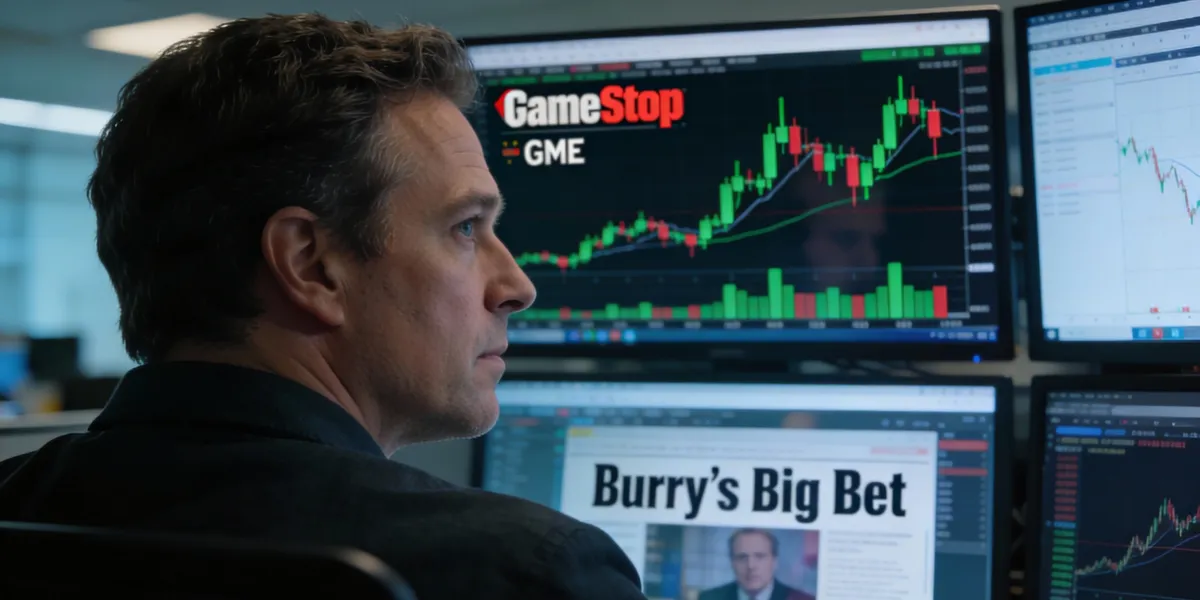
When Michael Burry speaks, markets listen. The legendary investor who predicted the 2008 housing collapse and earned immortality through his portrayal in "The Big Short" sent shockwaves through Wall Street on Monday after revealing he's been accumulating shares of GameStop Corp. The gaming retailer's stock surged following Burry's Substack announcement, reminding investors that whilst the meme stock frenzy may have faded from daily headlines, it never truly disappeared. For retail investors who watched GameStop's wild ride from thirty dollars to nearly five hundred dollars in early 2021, Burry's return raises crucial questions about timing, conviction, and whether lightning can strike the same meme stock twice.

GameStop shares jumped more than twelve per cent in Monday trading after Burry disclosed his renewed position, marking one of the stock's strongest single-day performances in months. The rally demonstrates that Burry's influence extends far beyond institutional circles—his contrarian bets have become cultural touchstones that retail investors follow closely. This isn't Burry's first dance with GameStop. He initially purchased shares in 2019 when the stock traded at approximately $4, long before Reddit's WallStreetBets community transformed it into a symbol of retail investor power. Burry exited that position profitably in 2020, missing the stratospheric January 2021 squeeze but still banking substantial gains. His return now, with GameStop trading around twenty-three dollars, suggests he sees value that markets are overlooking once again.
The context surrounding Burry's latest move differs dramatically from his original thesis. In 2019, GameStop was a struggling brick-and-mortar retailer with a business model threatened by digital game downloads, but its balance sheet and potential turnaround prospects were underappreciated. Today, GameStop has raised billions of dollars through stock offerings during the meme stock mania, eliminated most of its debt, and attempted various pivots, including ventures into non-fungible tokens and cryptocurrency. The company remains unprofitable, however, with same-store sales declining as foot traffic continues its migration to digital platforms. Burry's willingness to wade back into these waters signals he believes the market is once again mispricing the stock—either undervaluing its cash position and potential strategic moves or setting up for another technical squeeze.
The Burry effect and market psychology
Burry's influence on retail investor psychology cannot be overstated. His track record of spectacular contrarian calls—from the housing bubble to early positions in undervalued companies—has earned him a devoted following among individual investors seeking to replicate his success. When Burry announces a position, thousands of retail traders scrutinise his reasoning and often follow suit, creating what markets now recognise as the "Burry effect." This phenomenon played out in real-time on Monday, with GameStop's trading volume spiking dramatically as news spread across social media platforms and investment forums.

"Burry's return to GameStop represents more than just one investor's thesis—it's a signal that value-oriented contrarians are finding opportunities in former meme stocks that have been abandoned by momentum traders," says Rebecca Martinez, Senior Equity Analyst at Thornton Research Group. "His timing suggests he believes the negative sentiment has gone too far, creating a margin of safety that wasn't present during the peak mania."
The broader market implications extend beyond GameStop itself. Burry's move arrives as many former meme stocks trade at multi-year lows, having shed the frothy valuations that characterised 2021's retail trading boom. AMC Entertainment, Bed Bath & Beyond (now bankrupt), and other retail favourites have largely disappointed investors who bought near peaks. Burry's selective re-entry into GameStop—rather than a broader basket of meme stocks—suggests his thesis is company-specific rather than a bet on renewed retail enthusiasm. He likely sees concrete value in GameStop's substantial cash reserves, which exceed one billion dollars, and potential optionality in how management deploys that capital.
For retail investors, the critical lesson isn't simply to follow Burry into GameStop. Rather, it's understanding the analytical framework that might lead a sophisticated investor back to a controversial name. Burry typically identifies situations where market sentiment has detached from fundamental reality, where assets trade below intrinsic value due to temporary factors or misunderstood catalysts. His original GameStop thesis rested on the company's real estate assets, intellectual property, and customer loyalty programme being worth more than the market capitalisation. His current thesis remains undisclosed in detail, but investors can infer he sees similar mispricing today.
Navigating celebrity investor influence in your portfolio
The GameStop episode highlights both the opportunities and dangers of following celebrity investors. Whilst Burry's track record commands respect, retail investors must recognise that his investment horizon, risk tolerance, and portfolio construction differ dramatically from those of typical individual investors. Burry manages concentrated portfolios, can withstand significant volatility, and possesses the analytical resources to conduct deep due diligence. Simply mimicking his positions without understanding the underlying thesis can lead to painful losses, particularly in volatile names like GameStop, where timing matters enormously.
"The challenge for retail investors isn't identifying quality investors to follow—it's understanding that disclosure delays and different time horizons mean you're always trading on stale information," notes David Kowalski, Portfolio Manager at Riverside Capital Advisors. "By the time Burry announces a position publicly, he may have been accumulating for weeks or months, meaning your entry point differs substantially from his average cost."
GameStop's fundamentals remain hotly debated. Bulls point to the company's fortress balance sheet, potential for strategic pivots, and loyal customer base as foundations for recovery. Bears counter that the core business continues deteriorating, management hasn't articulated a compelling turnaround strategy, and the digital gaming revolution represents an existential threat. Burry clearly sides with the bulls, but his specific catalyst expectations remain unclear. Does he anticipate activist involvement? Strategic transactions? A crypto or NFT breakthrough? Or simply mean reversion to a higher valuation multiple on the cash pile? Without knowing these details, retail investors risk buying into a thesis they don't fully comprehend.
The technical setup also matters. GameStop maintains a substantial short interest, though nowhere near the extreme levels that fuelled the 2021 squeeze. Any positive catalyst—whether fundamental news or simply momentum from Burry's endorsement—could trigger short covering that amplifies gains. However, this sword cuts both ways: disappointing developments could prompt shorts to pile on aggressively, knowing that many recent buyers lack strong conviction beyond following Burry's lead.
"Meme stocks taught us that market structure matters as much as fundamentals in the short term," observes Jennifer Park, Chief Investment Strategist at Lexington Financial. "Burry's involvement adds another layer to GameStop's already complex dynamics, potentially attracting both genuine value investors and momentum traders chasing the Burry premium."
Looking ahead, retail investors should treat Burry's GameStop position as one data point rather than an investment mandate. The smartest approach involves conducting independent research, understanding your own risk tolerance, and sizing positions appropriately. If Burry's move prompts you to examine GameStop's fundamentals more closely, that analytical exercise provides value regardless of whether you ultimately invest. The broader lesson transcends this single stock: legendary investors offer valuable perspectives, but their superpower lies in contrarian conviction and patience—qualities retail investors must develop independently rather than borrow through imitation. As GameStop's latest chapter unfolds, those who understand both the opportunity and the risks will be best positioned to navigate whatever comes next in this ongoing market saga.
Disclaimer: The views and recommendations made above are those of individual analysts or brokerage companies, and not of Winvesta. We advise investors to check with certified experts before making any investment decisions.
Ready to earn on every trade?
Invest in 11,000+ US stocks & ETFs

When Michael Burry speaks, markets listen. The legendary investor who predicted the 2008 housing collapse and earned immortality through his portrayal in "The Big Short" sent shockwaves through Wall Street on Monday after revealing he's been accumulating shares of GameStop Corp. The gaming retailer's stock surged following Burry's Substack announcement, reminding investors that whilst the meme stock frenzy may have faded from daily headlines, it never truly disappeared. For retail investors who watched GameStop's wild ride from thirty dollars to nearly five hundred dollars in early 2021, Burry's return raises crucial questions about timing, conviction, and whether lightning can strike the same meme stock twice.
GameStop shares jumped more than twelve per cent in Monday trading after Burry disclosed his renewed position, marking one of the stock's strongest single-day performances in months. The rally demonstrates that Burry's influence extends far beyond institutional circles—his contrarian bets have become cultural touchstones that retail investors follow closely. This isn't Burry's first dance with GameStop. He initially purchased shares in 2019 when the stock traded at approximately $4, long before Reddit's WallStreetBets community transformed it into a symbol of retail investor power. Burry exited that position profitably in 2020, missing the stratospheric January 2021 squeeze but still banking substantial gains. His return now, with GameStop trading around twenty-three dollars, suggests he sees value that markets are overlooking once again.
The context surrounding Burry's latest move differs dramatically from his original thesis. In 2019, GameStop was a struggling brick-and-mortar retailer with a business model threatened by digital game downloads, but its balance sheet and potential turnaround prospects were underappreciated. Today, GameStop has raised billions of dollars through stock offerings during the meme stock mania, eliminated most of its debt, and attempted various pivots, including ventures into non-fungible tokens and cryptocurrency. The company remains unprofitable, however, with same-store sales declining as foot traffic continues its migration to digital platforms. Burry's willingness to wade back into these waters signals he believes the market is once again mispricing the stock—either undervaluing its cash position and potential strategic moves or setting up for another technical squeeze.
The Burry effect and market psychology
Burry's influence on retail investor psychology cannot be overstated. His track record of spectacular contrarian calls—from the housing bubble to early positions in undervalued companies—has earned him a devoted following among individual investors seeking to replicate his success. When Burry announces a position, thousands of retail traders scrutinise his reasoning and often follow suit, creating what markets now recognise as the "Burry effect." This phenomenon played out in real-time on Monday, with GameStop's trading volume spiking dramatically as news spread across social media platforms and investment forums.
"Burry's return to GameStop represents more than just one investor's thesis—it's a signal that value-oriented contrarians are finding opportunities in former meme stocks that have been abandoned by momentum traders," says Rebecca Martinez, Senior Equity Analyst at Thornton Research Group. "His timing suggests he believes the negative sentiment has gone too far, creating a margin of safety that wasn't present during the peak mania."
The broader market implications extend beyond GameStop itself. Burry's move arrives as many former meme stocks trade at multi-year lows, having shed the frothy valuations that characterised 2021's retail trading boom. AMC Entertainment, Bed Bath & Beyond (now bankrupt), and other retail favourites have largely disappointed investors who bought near peaks. Burry's selective re-entry into GameStop—rather than a broader basket of meme stocks—suggests his thesis is company-specific rather than a bet on renewed retail enthusiasm. He likely sees concrete value in GameStop's substantial cash reserves, which exceed one billion dollars, and potential optionality in how management deploys that capital.
For retail investors, the critical lesson isn't simply to follow Burry into GameStop. Rather, it's understanding the analytical framework that might lead a sophisticated investor back to a controversial name. Burry typically identifies situations where market sentiment has detached from fundamental reality, where assets trade below intrinsic value due to temporary factors or misunderstood catalysts. His original GameStop thesis rested on the company's real estate assets, intellectual property, and customer loyalty programme being worth more than the market capitalisation. His current thesis remains undisclosed in detail, but investors can infer he sees similar mispricing today.
Navigating celebrity investor influence in your portfolio
The GameStop episode highlights both the opportunities and dangers of following celebrity investors. Whilst Burry's track record commands respect, retail investors must recognise that his investment horizon, risk tolerance, and portfolio construction differ dramatically from those of typical individual investors. Burry manages concentrated portfolios, can withstand significant volatility, and possesses the analytical resources to conduct deep due diligence. Simply mimicking his positions without understanding the underlying thesis can lead to painful losses, particularly in volatile names like GameStop, where timing matters enormously.
"The challenge for retail investors isn't identifying quality investors to follow—it's understanding that disclosure delays and different time horizons mean you're always trading on stale information," notes David Kowalski, Portfolio Manager at Riverside Capital Advisors. "By the time Burry announces a position publicly, he may have been accumulating for weeks or months, meaning your entry point differs substantially from his average cost."
GameStop's fundamentals remain hotly debated. Bulls point to the company's fortress balance sheet, potential for strategic pivots, and loyal customer base as foundations for recovery. Bears counter that the core business continues deteriorating, management hasn't articulated a compelling turnaround strategy, and the digital gaming revolution represents an existential threat. Burry clearly sides with the bulls, but his specific catalyst expectations remain unclear. Does he anticipate activist involvement? Strategic transactions? A crypto or NFT breakthrough? Or simply mean reversion to a higher valuation multiple on the cash pile? Without knowing these details, retail investors risk buying into a thesis they don't fully comprehend.
The technical setup also matters. GameStop maintains a substantial short interest, though nowhere near the extreme levels that fuelled the 2021 squeeze. Any positive catalyst—whether fundamental news or simply momentum from Burry's endorsement—could trigger short covering that amplifies gains. However, this sword cuts both ways: disappointing developments could prompt shorts to pile on aggressively, knowing that many recent buyers lack strong conviction beyond following Burry's lead.
"Meme stocks taught us that market structure matters as much as fundamentals in the short term," observes Jennifer Park, Chief Investment Strategist at Lexington Financial. "Burry's involvement adds another layer to GameStop's already complex dynamics, potentially attracting both genuine value investors and momentum traders chasing the Burry premium."
Looking ahead, retail investors should treat Burry's GameStop position as one data point rather than an investment mandate. The smartest approach involves conducting independent research, understanding your own risk tolerance, and sizing positions appropriately. If Burry's move prompts you to examine GameStop's fundamentals more closely, that analytical exercise provides value regardless of whether you ultimately invest. The broader lesson transcends this single stock: legendary investors offer valuable perspectives, but their superpower lies in contrarian conviction and patience—qualities retail investors must develop independently rather than borrow through imitation. As GameStop's latest chapter unfolds, those who understand both the opportunity and the risks will be best positioned to navigate whatever comes next in this ongoing market saga.
Disclaimer: The views and recommendations made above are those of individual analysts or brokerage companies, and not of Winvesta. We advise investors to check with certified experts before making any investment decisions.
Ready to earn on every trade?
Invest in 11,000+ US stocks & ETFs


