Fed under fire: How the Powell probe could reshape your investment strategy
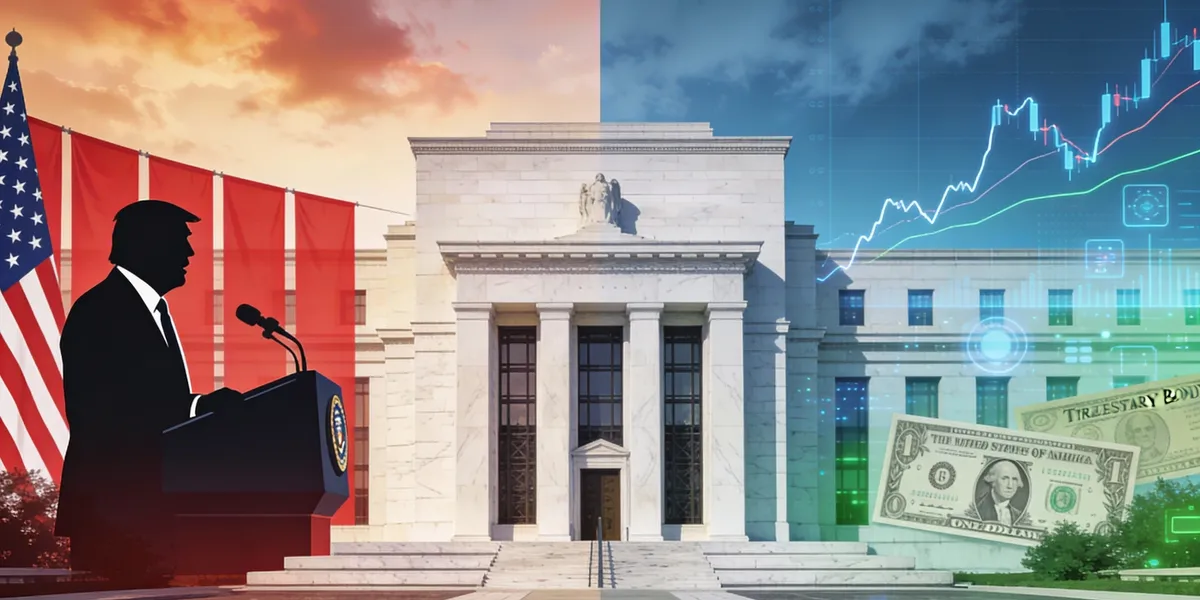
The delicate balance between political power and monetary policy independence faces its most serious test in decades as President Donald Trump publicly endorsed a criminal investigation into Federal Reserve Chairman Jerome Powell, whilst simultaneously nominating Kevin Warsh as his preferred successor. This extraordinary development sent shockwaves through financial markets on Monday, raising fundamental questions about the future of interest rate policy and the institutional framework that has governed American monetary policy since the Federal Reserve's creation in 1913. For investors holding everything from technology stocks to Treasury bonds, the implications extend far beyond Washington politics into the very foundation of portfolio valuations and market stability.
The controversy intensified when Senator Thom Tillis announced he would block any new Federal Reserve nominees until the Powell investigation reaches a conclusion, creating an unprecedented standoff that could leave America's central bank in leadership limbo during a critical period for monetary policy. Markets have grown accustomed to Powell's measured approach to interest rate decisions, and the prospect of political interference threatens to undermine the credibility that allows the Fed to manage inflation expectations without triggering market panic. The S&P 500 declined 1.3 per cent in afternoon trading as investors digested the news, whilst Treasury yields fluctuated wildly as traders recalibrated their expectations for future rate decisions.
Jerome Powell's tenure as Fed Chair has been marked by relative independence despite previous criticism from Trump during his first term, when the former president repeatedly called for lower interest rates to stimulate economic growth. The current investigation marks an escalation that goes beyond policy disagreements into the realm of potential criminal liability, though the specific allegations remain unclear. What is abundantly clear, however, is that any perception of political control over monetary policy could fundamentally alter how markets price risk across every asset class. When central banks lose credibility, inflation expectations become unanchored, bond markets revolt, and equity valuations compress as investors demand higher risk premiums.
The independence premium: What investors stand to lose
Central bank independence isn't merely an abstract principle debated in economics textbooks—it represents real value in your portfolio. Countries with politically controlled central banks have historically experienced higher inflation volatility, wider credit spreads, and lower equity valuations, as investors price in the risk that policy decisions are driven by electoral cycles rather than economic fundamentals. The United States has benefited from what markets call an "independence premium" that keeps borrowing costs lower and supports higher price-to-earnings ratios than would otherwise be justified. This premium could erode rapidly if political pressure compromises the Federal Reserve's decision-making process.

The nomination of Kevin Warsh as Trump's preferred Fed Chair replacement adds another layer of complexity to the situation. Warsh served as a Federal Reserve governor from 2006 to 2011 and has maintained relationships within Republican circles that could make him more amenable to political influence, though he has generally supported traditional central banking principles during his career. Markets now face the uncomfortable task of pricing in multiple scenarios: a diminished Powell completing his term under investigation, an early departure triggering a confirmation battle in the Senate, or a prolonged leadership vacuum if Tillis makes good on his threat to block nominees. None of these scenarios inspires confidence amongst investors seeking stability.
"The Fed's credibility is its most valuable asset, and that credibility rests on the perception that monetary policy decisions are made independently based on economic data rather than political considerations," says Michael Reynolds, Vice President of Investment Strategy at Glenmede. "Any erosion of that perception will be immediately reflected in market pricing across bonds, equities, and currencies."
The practical implications for retail investors are substantial. Technology stocks, which dominate many retirement portfolios through index funds, are particularly sensitive to interest rate expectations because their valuations depend heavily on discounting future cash flows. A Fed perceived as susceptible to political pressure favouring lower rates might initially seem positive for growth stocks, but the accompanying surge in inflation expectations and term premiums would likely overwhelm any benefit. Financial sector stocks face a different calculation, as banks profit from steeper yield curves but suffer when economic uncertainty crimps lending activity and regulatory oversight intensifies.
Navigating portfolio risk in an era of monetary policy uncertainty
The current situation creates a challenging environment for investors who have grown accustomed to relatively predictable Fed behaviour over the past fifteen years. Powell's data-dependent approach to monetary policy has provided markets with a framework for anticipating rate decisions, allowing investors to position portfolios accordingly. That framework now faces fundamental uncertainty as political considerations potentially enter the equation. Bond investors confront particularly acute challenges, as Treasury yields must simultaneously reflect inflation expectations, real interest rate projections, and a new term premium compensating for political risk that hasn't meaningfully existed in modern American markets.
Diversification takes on renewed importance in this environment, though traditional correlations between stocks and bonds may shift if monetary policy credibility deteriorates. Historical episodes of central bank independence challenges in developed markets suggest that real assets, international diversification, and inflation-protected securities become increasingly valuable as hedges against policy uncertainty. Gold prices rose 2.1 per cent on Monday as investors sought traditional safe havens, whilst inflation-protected Treasury securities outperformed nominal bonds.

"Investors should resist the temptation to make dramatic portfolio changes based on political headlines, but this situation warrants a serious review of interest rate sensitivity across your holdings," notes Catherine Anderson, Chief Investment Officer at Brookfield Asset Management. "The risk isn't just higher or lower rates—it's the unpredictability that comes from politicised monetary policy."
The international dimension cannot be ignored, as foreign investors hold approximately 7.5 trillion dollars in U.S. Treasury securities and rely on Fed independence to protect the value of those holdings. Any sustained perception that American monetary policy has become politically compromised could trigger capital flows that push the dollar lower and force yields higher to attract continued foreign investment. This dynamic would create headwinds for domestic companies whilst potentially benefiting exporters and multinational corporations that generate revenue overseas.
Looking ahead, investors should monitor several key indicators that will signal whether this controversy remains political theatre or evolves into a genuine threat to monetary policy independence. The Fed's next policy statement will be scrutinised for any language suggesting external pressure on decision-making, whilst bond market measures of inflation expectations will reveal whether investors believe the central bank retains credibility. Senator Tillis's confirmation blockade creates a timeline forcing resolution before any leadership transition can occur, potentially extending uncertainty for months. In the meantime, maintaining portfolio resilience through proper diversification whilst avoiding panic-driven decisions represents the most prudent path forward as this unprecedented situation unfolds.
Disclaimer: The views and recommendations made above are those of individual analysts or brokerage companies, and not of Winvesta. We advise investors to check with certified experts before making any investment decisions.
Ready to earn on every trade?
Invest in 11,000+ US stocks & ETFs

The delicate balance between political power and monetary policy independence faces its most serious test in decades as President Donald Trump publicly endorsed a criminal investigation into Federal Reserve Chairman Jerome Powell, whilst simultaneously nominating Kevin Warsh as his preferred successor. This extraordinary development sent shockwaves through financial markets on Monday, raising fundamental questions about the future of interest rate policy and the institutional framework that has governed American monetary policy since the Federal Reserve's creation in 1913. For investors holding everything from technology stocks to Treasury bonds, the implications extend far beyond Washington politics into the very foundation of portfolio valuations and market stability.
The controversy intensified when Senator Thom Tillis announced he would block any new Federal Reserve nominees until the Powell investigation reaches a conclusion, creating an unprecedented standoff that could leave America's central bank in leadership limbo during a critical period for monetary policy. Markets have grown accustomed to Powell's measured approach to interest rate decisions, and the prospect of political interference threatens to undermine the credibility that allows the Fed to manage inflation expectations without triggering market panic. The S&P 500 declined 1.3 per cent in afternoon trading as investors digested the news, whilst Treasury yields fluctuated wildly as traders recalibrated their expectations for future rate decisions.
Jerome Powell's tenure as Fed Chair has been marked by relative independence despite previous criticism from Trump during his first term, when the former president repeatedly called for lower interest rates to stimulate economic growth. The current investigation marks an escalation that goes beyond policy disagreements into the realm of potential criminal liability, though the specific allegations remain unclear. What is abundantly clear, however, is that any perception of political control over monetary policy could fundamentally alter how markets price risk across every asset class. When central banks lose credibility, inflation expectations become unanchored, bond markets revolt, and equity valuations compress as investors demand higher risk premiums.
The independence premium: What investors stand to lose
Central bank independence isn't merely an abstract principle debated in economics textbooks—it represents real value in your portfolio. Countries with politically controlled central banks have historically experienced higher inflation volatility, wider credit spreads, and lower equity valuations, as investors price in the risk that policy decisions are driven by electoral cycles rather than economic fundamentals. The United States has benefited from what markets call an "independence premium" that keeps borrowing costs lower and supports higher price-to-earnings ratios than would otherwise be justified. This premium could erode rapidly if political pressure compromises the Federal Reserve's decision-making process.
The nomination of Kevin Warsh as Trump's preferred Fed Chair replacement adds another layer of complexity to the situation. Warsh served as a Federal Reserve governor from 2006 to 2011 and has maintained relationships within Republican circles that could make him more amenable to political influence, though he has generally supported traditional central banking principles during his career. Markets now face the uncomfortable task of pricing in multiple scenarios: a diminished Powell completing his term under investigation, an early departure triggering a confirmation battle in the Senate, or a prolonged leadership vacuum if Tillis makes good on his threat to block nominees. None of these scenarios inspires confidence amongst investors seeking stability.
"The Fed's credibility is its most valuable asset, and that credibility rests on the perception that monetary policy decisions are made independently based on economic data rather than political considerations," says Michael Reynolds, Vice President of Investment Strategy at Glenmede. "Any erosion of that perception will be immediately reflected in market pricing across bonds, equities, and currencies."
The practical implications for retail investors are substantial. Technology stocks, which dominate many retirement portfolios through index funds, are particularly sensitive to interest rate expectations because their valuations depend heavily on discounting future cash flows. A Fed perceived as susceptible to political pressure favouring lower rates might initially seem positive for growth stocks, but the accompanying surge in inflation expectations and term premiums would likely overwhelm any benefit. Financial sector stocks face a different calculation, as banks profit from steeper yield curves but suffer when economic uncertainty crimps lending activity and regulatory oversight intensifies.
Navigating portfolio risk in an era of monetary policy uncertainty
The current situation creates a challenging environment for investors who have grown accustomed to relatively predictable Fed behaviour over the past fifteen years. Powell's data-dependent approach to monetary policy has provided markets with a framework for anticipating rate decisions, allowing investors to position portfolios accordingly. That framework now faces fundamental uncertainty as political considerations potentially enter the equation. Bond investors confront particularly acute challenges, as Treasury yields must simultaneously reflect inflation expectations, real interest rate projections, and a new term premium compensating for political risk that hasn't meaningfully existed in modern American markets.
Diversification takes on renewed importance in this environment, though traditional correlations between stocks and bonds may shift if monetary policy credibility deteriorates. Historical episodes of central bank independence challenges in developed markets suggest that real assets, international diversification, and inflation-protected securities become increasingly valuable as hedges against policy uncertainty. Gold prices rose 2.1 per cent on Monday as investors sought traditional safe havens, whilst inflation-protected Treasury securities outperformed nominal bonds.
"Investors should resist the temptation to make dramatic portfolio changes based on political headlines, but this situation warrants a serious review of interest rate sensitivity across your holdings," notes Catherine Anderson, Chief Investment Officer at Brookfield Asset Management. "The risk isn't just higher or lower rates—it's the unpredictability that comes from politicised monetary policy."
The international dimension cannot be ignored, as foreign investors hold approximately 7.5 trillion dollars in U.S. Treasury securities and rely on Fed independence to protect the value of those holdings. Any sustained perception that American monetary policy has become politically compromised could trigger capital flows that push the dollar lower and force yields higher to attract continued foreign investment. This dynamic would create headwinds for domestic companies whilst potentially benefiting exporters and multinational corporations that generate revenue overseas.
Looking ahead, investors should monitor several key indicators that will signal whether this controversy remains political theatre or evolves into a genuine threat to monetary policy independence. The Fed's next policy statement will be scrutinised for any language suggesting external pressure on decision-making, whilst bond market measures of inflation expectations will reveal whether investors believe the central bank retains credibility. Senator Tillis's confirmation blockade creates a timeline forcing resolution before any leadership transition can occur, potentially extending uncertainty for months. In the meantime, maintaining portfolio resilience through proper diversification whilst avoiding panic-driven decisions represents the most prudent path forward as this unprecedented situation unfolds.
Disclaimer: The views and recommendations made above are those of individual analysts or brokerage companies, and not of Winvesta. We advise investors to check with certified experts before making any investment decisions.
Ready to earn on every trade?
Invest in 11,000+ US stocks & ETFs


