Alphabet's $185 billion capex plan rattles tech investors
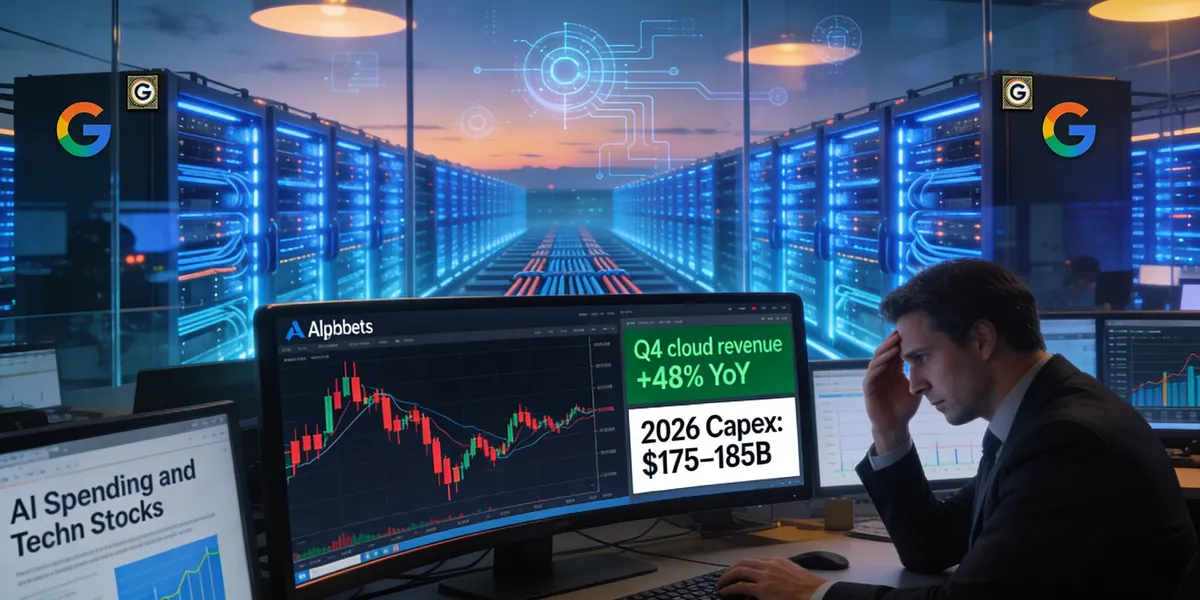
Alphabet delivered precisely what Wall Street wanted in its fourth-quarter earnings report—except for one jarring detail that sent investors scrambling to recalibrate their expectations. Whilst the tech giant handily beat revenue and profit forecasts, with its cloud division surging nearly 48% year-over-year, the company's bombshell capital expenditure guidance overshadowed the otherwise stellar performance. Management announced plans to spend between $175 billion and $185 billion on infrastructure in 2026, a figure that could more than double last year's outlay and represents one of the largest corporate investment commitments in history. The market's reaction was swift and unforgiving, as investors grappled with what this aggressive spending spree means for profitability, competitive positioning, and the broader artificial intelligence arms race reshaping the technology sector.
The magnitude of Alphabet's planned expenditure cannot be overstated. At the upper end of guidance, the company would be allocating roughly $185 billion towards data centres, computing infrastructure, and AI capabilities—an amount that exceeds the entire annual GDP of nations like Hungary or New Zealand. This represents a fundamental shift in corporate strategy, signalling that Google's parent company believes the AI revolution requires investment at a scale previously unimaginable. The spending will primarily fund the construction of massive data centres equipped with advanced semiconductors, cooling systems, and networking infrastructure necessary to train and deploy ever-larger AI models. For context, Meta Platforms recently outlined plans to spend approximately $65 billion on similar infrastructure, whilst Amazon Web Services continues to expand its global footprint with tens of billions in annual capital commitments.

The immediate market response reflected investor anxiety about near-term profitability. Even as Alphabet's cloud division demonstrated robust growth momentum and its core advertising business remained resilient, shareholders focused on the implications of such extraordinary capital intensity. The concern centres on whether these investments will generate sufficient returns to justify their scale, or whether they'll compress margins and free cash flow for years to come. This tension between growth investment and shareholder returns has become the defining debate across the technology sector as companies race to establish dominance in generative AI capabilities.
The profitability trade-off that's reshaping valuations
What troubles investors most isn't merely the absolute spending level—it's the uncertainty surrounding return on investment and the timeframe for monetisation. Alphabet has historically operated with enviable profit margins, converting its search advertising dominance into substantial free cash flow that funded everything from moonshot projects to generous share buybacks. The proposed capex programme threatens to disrupt this comfortable equilibrium, potentially reducing near-term earnings whilst the company builds out infrastructure that may take years to fully monetise. The cloud division's impressive 48% revenue growth offers some reassurance, demonstrating strong demand for AI-powered services, yet questions remain about pricing power and competitive dynamics as Microsoft, Amazon, and others pursue similar strategies.
The spending also raises concerns about capital allocation discipline. Technology companies have occasionally stumbled when pursuing infrastructure buildouts at scale, sometimes overestimating demand or underestimating competitive pressures. The telecommunications industry's fibre-optic overbuilding in the early 2000s serves as a cautionary tale of excessive capital investment chasing uncertain returns. Alphabet's management argues that failing to invest aggressively now would cede competitive positioning to rivals, particularly as artificial intelligence becomes embedded in every aspect of computing. The strategic calculus suggests that falling behind in AI infrastructure could prove more costly than temporarily elevated capital expenditure.
"We're witnessing a historic reallocation of corporate resources towards AI infrastructure, and Alphabet's guidance represents the clearest signal yet that tech giants view this as an existential investment," says Michael Thornton, Chief Technology Strategist at Redwood Capital Advisors.
The market's skittishness reflects broader uncertainty about how to value companies amidst this AI transition. Traditional valuation metrics like price-to-earnings ratios become less reliable when companies dramatically increase capital intensity, potentially depressing near-term earnings whilst building long-term competitive moats. Investors must decide whether current share prices adequately reflect both the investment burden and the potential upside from AI leadership. This calculus becomes particularly challenging when competitors are making similar bets, suggesting that heavy spending may be necessary just to maintain market position rather than to capture outsized returns.
Ripple effects across the technology landscape
Alphabet's announcement carries implications far beyond its own share price, reshaping expectations across the entire technology sector. Advanced Micro Devices experienced particularly brutal trading following the earnings release, as investors reassessed which semiconductor companies would benefit most from the AI infrastructure buildout. The interconnected nature of technology supply chains means that shifts in capex spending patterns by major cloud providers cascade through chip manufacturers, equipment suppliers, and data centre operators. AMD's struggles highlighted investor concerns about competitive positioning relative to NVIDIA, which has captured the lion's share of AI chip demand with its dominant graphics processing units.
The broader market reaction also reflects anxiety about sector-wide margin compression as multiple tech giants pursue aggressive infrastructure investments simultaneously. When Alphabet, Microsoft, Amazon, and Meta all commit to elevated capital expenditure programmes, it suggests an arms race dynamic where no single player can afford to underinvest. This creates a challenging environment for investors seeking to identify relative winners, as success may ultimately depend on execution quality and monetisation strategy rather than sheer spending levels. The sustainability of current technology valuations comes into question when profit margins face sustained pressure from capital intensity.
"Investors need to distinguish between productive investment that generates competitive advantages and defensive spending that simply maintains market position," notes Patricia Chen, Senior Portfolio Manager at Horizon Investment Management. "Alphabet's challenge is demonstrating that $185 billion in capex will translate into differentiated AI capabilities rather than matching competitors' infrastructure."
For retail investors holding technology stocks, Alphabet's guidance demands careful portfolio reassessment. The company remains fundamentally strong with dominant market positions, substantial cash generation, and proven execution capabilities. However, the investment thesis has shifted from a cash-generative business returning substantial capital to shareholders towards a capital-intensive growth story requiring patience and tolerance for near-term margin pressure. Diversification across the technology sector becomes more important as different companies pursue varying strategies for navigating the AI transition, with some prioritising immediate profitability whilst others chase market share through aggressive investment.
The coming quarters will prove crucial in determining whether Alphabet's bold spending plan represents visionary leadership or excessive exuberance. Investors should monitor cloud revenue growth acceleration, AI product monetisation progress, and relative competitive positioning against Microsoft and Amazon. The capex programme's success ultimately hinges on whether generative AI applications drive sufficient enterprise and consumer spending to justify the infrastructure investments underpinning them. As this drama unfolds, the technology sector's valuation landscape will continue evolving, requiring investors to balance near-term profitability concerns against long-term positioning in what may prove to be computing's most transformative era.
Disclaimer: The views and recommendations made above are those of individual analysts or brokerage companies, and not of Winvesta. We advise investors to check with certified experts before making any investment decisions.
Ready to earn on every trade?
Invest in 11,000+ US stocks & ETFs

Alphabet delivered precisely what Wall Street wanted in its fourth-quarter earnings report—except for one jarring detail that sent investors scrambling to recalibrate their expectations. Whilst the tech giant handily beat revenue and profit forecasts, with its cloud division surging nearly 48% year-over-year, the company's bombshell capital expenditure guidance overshadowed the otherwise stellar performance. Management announced plans to spend between $175 billion and $185 billion on infrastructure in 2026, a figure that could more than double last year's outlay and represents one of the largest corporate investment commitments in history. The market's reaction was swift and unforgiving, as investors grappled with what this aggressive spending spree means for profitability, competitive positioning, and the broader artificial intelligence arms race reshaping the technology sector.
The magnitude of Alphabet's planned expenditure cannot be overstated. At the upper end of guidance, the company would be allocating roughly $185 billion towards data centres, computing infrastructure, and AI capabilities—an amount that exceeds the entire annual GDP of nations like Hungary or New Zealand. This represents a fundamental shift in corporate strategy, signalling that Google's parent company believes the AI revolution requires investment at a scale previously unimaginable. The spending will primarily fund the construction of massive data centres equipped with advanced semiconductors, cooling systems, and networking infrastructure necessary to train and deploy ever-larger AI models. For context, Meta Platforms recently outlined plans to spend approximately $65 billion on similar infrastructure, whilst Amazon Web Services continues to expand its global footprint with tens of billions in annual capital commitments.
The immediate market response reflected investor anxiety about near-term profitability. Even as Alphabet's cloud division demonstrated robust growth momentum and its core advertising business remained resilient, shareholders focused on the implications of such extraordinary capital intensity. The concern centres on whether these investments will generate sufficient returns to justify their scale, or whether they'll compress margins and free cash flow for years to come. This tension between growth investment and shareholder returns has become the defining debate across the technology sector as companies race to establish dominance in generative AI capabilities.
The profitability trade-off that's reshaping valuations
What troubles investors most isn't merely the absolute spending level—it's the uncertainty surrounding return on investment and the timeframe for monetisation. Alphabet has historically operated with enviable profit margins, converting its search advertising dominance into substantial free cash flow that funded everything from moonshot projects to generous share buybacks. The proposed capex programme threatens to disrupt this comfortable equilibrium, potentially reducing near-term earnings whilst the company builds out infrastructure that may take years to fully monetise. The cloud division's impressive 48% revenue growth offers some reassurance, demonstrating strong demand for AI-powered services, yet questions remain about pricing power and competitive dynamics as Microsoft, Amazon, and others pursue similar strategies.
The spending also raises concerns about capital allocation discipline. Technology companies have occasionally stumbled when pursuing infrastructure buildouts at scale, sometimes overestimating demand or underestimating competitive pressures. The telecommunications industry's fibre-optic overbuilding in the early 2000s serves as a cautionary tale of excessive capital investment chasing uncertain returns. Alphabet's management argues that failing to invest aggressively now would cede competitive positioning to rivals, particularly as artificial intelligence becomes embedded in every aspect of computing. The strategic calculus suggests that falling behind in AI infrastructure could prove more costly than temporarily elevated capital expenditure.
"We're witnessing a historic reallocation of corporate resources towards AI infrastructure, and Alphabet's guidance represents the clearest signal yet that tech giants view this as an existential investment," says Michael Thornton, Chief Technology Strategist at Redwood Capital Advisors.
The market's skittishness reflects broader uncertainty about how to value companies amidst this AI transition. Traditional valuation metrics like price-to-earnings ratios become less reliable when companies dramatically increase capital intensity, potentially depressing near-term earnings whilst building long-term competitive moats. Investors must decide whether current share prices adequately reflect both the investment burden and the potential upside from AI leadership. This calculus becomes particularly challenging when competitors are making similar bets, suggesting that heavy spending may be necessary just to maintain market position rather than to capture outsized returns.
Ripple effects across the technology landscape
Alphabet's announcement carries implications far beyond its own share price, reshaping expectations across the entire technology sector. Advanced Micro Devices experienced particularly brutal trading following the earnings release, as investors reassessed which semiconductor companies would benefit most from the AI infrastructure buildout. The interconnected nature of technology supply chains means that shifts in capex spending patterns by major cloud providers cascade through chip manufacturers, equipment suppliers, and data centre operators. AMD's struggles highlighted investor concerns about competitive positioning relative to NVIDIA, which has captured the lion's share of AI chip demand with its dominant graphics processing units.
The broader market reaction also reflects anxiety about sector-wide margin compression as multiple tech giants pursue aggressive infrastructure investments simultaneously. When Alphabet, Microsoft, Amazon, and Meta all commit to elevated capital expenditure programmes, it suggests an arms race dynamic where no single player can afford to underinvest. This creates a challenging environment for investors seeking to identify relative winners, as success may ultimately depend on execution quality and monetisation strategy rather than sheer spending levels. The sustainability of current technology valuations comes into question when profit margins face sustained pressure from capital intensity.
"Investors need to distinguish between productive investment that generates competitive advantages and defensive spending that simply maintains market position," notes Patricia Chen, Senior Portfolio Manager at Horizon Investment Management. "Alphabet's challenge is demonstrating that $185 billion in capex will translate into differentiated AI capabilities rather than matching competitors' infrastructure."
For retail investors holding technology stocks, Alphabet's guidance demands careful portfolio reassessment. The company remains fundamentally strong with dominant market positions, substantial cash generation, and proven execution capabilities. However, the investment thesis has shifted from a cash-generative business returning substantial capital to shareholders towards a capital-intensive growth story requiring patience and tolerance for near-term margin pressure. Diversification across the technology sector becomes more important as different companies pursue varying strategies for navigating the AI transition, with some prioritising immediate profitability whilst others chase market share through aggressive investment.
The coming quarters will prove crucial in determining whether Alphabet's bold spending plan represents visionary leadership or excessive exuberance. Investors should monitor cloud revenue growth acceleration, AI product monetisation progress, and relative competitive positioning against Microsoft and Amazon. The capex programme's success ultimately hinges on whether generative AI applications drive sufficient enterprise and consumer spending to justify the infrastructure investments underpinning them. As this drama unfolds, the technology sector's valuation landscape will continue evolving, requiring investors to balance near-term profitability concerns against long-term positioning in what may prove to be computing's most transformative era.
Disclaimer: The views and recommendations made above are those of individual analysts or brokerage companies, and not of Winvesta. We advise investors to check with certified experts before making any investment decisions.
Ready to earn on every trade?
Invest in 11,000+ US stocks & ETFs


