SAC code for export of services: the 2026 list, and why it isn't your purpose code
You have finished the work, the client in Austin is happy, and all that stands between you and a paid invoice is a six-digit number your accountant just asked for. So you search for the SAC code for export of services, and page one hands you three different answers, two of which contradict each other on exactly the same kind of work.
This is a solved problem that reads like an unsolved one, largely because three separate numbering systems all get called the code by different people in the same conversation. Below is the list you came for, the distinction that actually matters, and one change arriving on 1 October 2026 that turns your SAC from an invoice formality into a regulatory field.
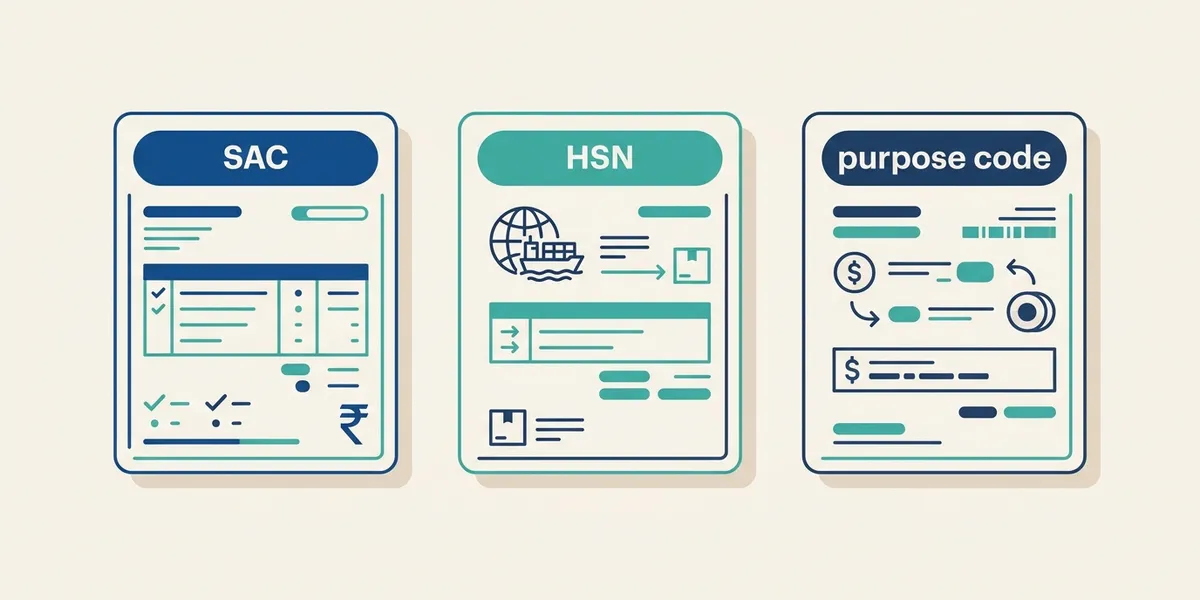
SAC, HSN and purpose code: three codes doing three different jobs
Almost every wrong answer online comes from collapsing these three into one. They are issued by different authorities, they sit on different documents, and getting one right does nothing to make the others right.
SAC, the Services Accounting Code, is a GST classification. It comes from the CBIC scheme of classification of services, every code begins with 99, and its job is to tell the GST system what kind of service you sold. It belongs on your invoice and in your GSTR-1.
HSN is the goods equivalent. If you export software on a physical medium or ship anything tangible, you need an HSN code. If you export a service, you do not. Software delivered electronically is a service, which is why so many Indian IT exporters get told to find an HSN code they will never need.
The RBI purpose code is a different animal entirely. Codes like P0802 or P1006 are FETERS codes used by the banking system to classify why foreign currency entered India. They live on your bank paperwork and your FIRA, never on your GST invoice. If you have not met them yet, start with our guide to RBI purpose codes.
The short version: SAC answers what did you sell, for the tax authority. The purpose code answers why did this money arrive, for the central bank. One invoice can carry a SAC and generate a payment with a purpose code, and the two need not resemble each other at all.
The SAC codes Indian service exporters actually use
Service codes sit in Chapter 99. Most Indian service exporters live inside a handful of them, listed below by the kind of work rather than by numerical order. Treat this as the shortlist to check against the CBIC scheme of classification of services, not as a substitute for it, and have your CA confirm the final choice before it goes on a return.
Software, IT and technology work sits under 9983. Use 998313 for IT consulting and support, 998314 for IT design and development, 998315 for hosting and infrastructure provisioning, 998316 for infrastructure and network management, and 998319 for other IT services not covered elsewhere. The first two carry most of India's software export invoicing between them.
Consulting and advisory work splits two ways. 998311 covers management consulting and management services; 998312 covers business consulting. The line between them is thin in practice, and either will withstand scrutiny provided your invoice description matches the one you pick and you stay consistent across quarters.
Design, marketing and research. Specialty design services, which is where graphic and product design land, is 998391. Advertising services is 998361. Market research and public opinion polling sits under 99837, with 998371 for market research itself. Content writing and copywriting usually fall to 998399, the catch-all for other professional, technical and business services.
Engineering, accounting and training. Engineering advisory services is 998331 and architectural advisory is 998321. Accounting and bookkeeping is 998222, financial auditing 998221, and corporate tax consulting 998231. Commercial training and coaching sits outside Chapter 9983 entirely, at 999293, which catches a lot of Indian exporters who assume every service code starts with 9983.
998313 or 998314: why page one of Google contradicts itself
Search for the SAC code for web development and you will be told 998313 by one result and 998314 by another, sometimes on the same page. Both codes are real and neither answer is universally wrong, which is exactly why the confusion survives.
The distinction is whether you built something or advised on something. If you wrote the code, designed the application, or delivered a working product, that is design and development: 998314. If you reviewed an architecture, advised on a migration, or provided ongoing support and troubleshooting for a system someone else runs, that is consulting and support: 998313.
A retainer that mixes both is common. Pick the code matching the dominant activity, describe the work honestly on the invoice, and keep the choice stable. Auditors are far more interested in whether your description, code and contract tell the same story than in which of two adjacent codes you landed on.
From 1 October 2026, your SAC stops being just a GST field
Until now, the SAC has been a GST concern. That changes when the new export regulations commence. Notification FEMA 23(R)/2026-RB, dated 13 January 2026 and gazetted on 15 January 2026, takes effect on 1 October 2026 and replaces SOFTEX with a single Export Declaration Form covering goods, services and software alike. Legacy SOFTEX filings continue until 30 September 2026.
The detail that matters here: the annex to that new EDF captures your GSTIN, PAN, IE Code and SAC, alongside third-party payment details. In other words, the same service code you have been putting on GST invoices becomes a declared field in your FEMA export filing, sitting next to your GSTIN in a form your AD bank certifies.
That creates a reconciliation surface that did not exist before. A SAC that disagrees with your invoice description, or drifts between your GST return and your export declaration, is now visible to two systems instead of one. There is also relief in the same regulation: service exporters other than software exporters may file the EDF on or before the date they receive payment, rather than within 30 days of the month end, and an AD bank can extend that window on request.
Software exporters get a second easing worth noting: certification can come from your AD bank or STPI, where STPI attestation used to be the default route. None of this is live yet, and AD banks are still publishing the standard operating procedures the regulation requires of them, so treat the next few weeks as preparation rather than action.
You still need a SAC even though your export is zero-rated
Export of services is zero-rated under GST, and a lot of exporters conclude from this that classification stops mattering. It does not. Zero-rated means the rate applied is nil, not that the supply is outside GST. You still raise a tax invoice, you still classify the service, and you still report it in GSTR-1.
Two practical consequences follow. First, you need a Letter of Undertaking on file for the financial year, or you pay 18% IGST upfront and claim it back later. Second, the zero rate depends on the export conditions being met, including receipt in convertible foreign exchange, which is what your FIRA or e-BRC evidences. The SAC is the thread tying the invoice to both.
What actually happens when the SAC does not match
Nobody arrives at your door over a misclassified consulting invoice. The failure is slower and more annoying than that. A SAC that disagrees with the service described on the invoice becomes a query during refund processing, a mismatch flag when your realisation data is cross-checked against your GST filings, or a request for clarification from a bank official who cannot reconcile what the paperwork says.
That cross-checking has been tightening. DGFT now requires GSTIN, GST invoice number and GST invoice date as mandatory fields on e-BRCs, which ties each realisation directly to a specific GST invoice. Once your export declaration also carries the SAC from October, three documents have to agree where previously they were only loosely coupled. Consistency is cheaper than correction.
Getting the paperwork to agree with itself
Pick the SAC that matches what you actually did, write an invoice description that says the same thing in words, and use the purpose code that fits the payment when the money lands. Three codes, three jobs, one consistent story. That is the whole discipline.
A Winvesta Global Collections Account handles the payment side of that story: local USD, GBP and EUR account details your client pays into as a domestic transfer, and a FIRA issued for every credit so your realisation evidence is ready when the GST refund or e-BRC needs it. The classification is still yours and your CA's call. Making sure the money arrives with clean documentation behind it is ours.
Disclaimer: The information provided in this blog is for general informational purposes only and does not constitute financial or legal advice. Winvesta makes no representations or warranties about the accuracy or suitability of the content and recommends consulting a professional before making any financial decisions.
Get paid globally. Keep more of it.
No FX markups. No GST. Funds in 1 day.

Table of Contents
You have finished the work, the client in Austin is happy, and all that stands between you and a paid invoice is a six-digit number your accountant just asked for. So you search for the SAC code for export of services, and page one hands you three different answers, two of which contradict each other on exactly the same kind of work.
This is a solved problem that reads like an unsolved one, largely because three separate numbering systems all get called the code by different people in the same conversation. Below is the list you came for, the distinction that actually matters, and one change arriving on 1 October 2026 that turns your SAC from an invoice formality into a regulatory field.
SAC, HSN and purpose code: three codes doing three different jobs
Almost every wrong answer online comes from collapsing these three into one. They are issued by different authorities, they sit on different documents, and getting one right does nothing to make the others right.
SAC, the Services Accounting Code, is a GST classification. It comes from the CBIC scheme of classification of services, every code begins with 99, and its job is to tell the GST system what kind of service you sold. It belongs on your invoice and in your GSTR-1.
HSN is the goods equivalent. If you export software on a physical medium or ship anything tangible, you need an HSN code. If you export a service, you do not. Software delivered electronically is a service, which is why so many Indian IT exporters get told to find an HSN code they will never need.
The RBI purpose code is a different animal entirely. Codes like P0802 or P1006 are FETERS codes used by the banking system to classify why foreign currency entered India. They live on your bank paperwork and your FIRA, never on your GST invoice. If you have not met them yet, start with our guide to RBI purpose codes.
The short version: SAC answers what did you sell, for the tax authority. The purpose code answers why did this money arrive, for the central bank. One invoice can carry a SAC and generate a payment with a purpose code, and the two need not resemble each other at all.
The SAC codes Indian service exporters actually use
Service codes sit in Chapter 99. Most Indian service exporters live inside a handful of them, listed below by the kind of work rather than by numerical order. Treat this as the shortlist to check against the CBIC scheme of classification of services, not as a substitute for it, and have your CA confirm the final choice before it goes on a return.
Software, IT and technology work sits under 9983. Use 998313 for IT consulting and support, 998314 for IT design and development, 998315 for hosting and infrastructure provisioning, 998316 for infrastructure and network management, and 998319 for other IT services not covered elsewhere. The first two carry most of India's software export invoicing between them.
Consulting and advisory work splits two ways. 998311 covers management consulting and management services; 998312 covers business consulting. The line between them is thin in practice, and either will withstand scrutiny provided your invoice description matches the one you pick and you stay consistent across quarters.
Design, marketing and research. Specialty design services, which is where graphic and product design land, is 998391. Advertising services is 998361. Market research and public opinion polling sits under 99837, with 998371 for market research itself. Content writing and copywriting usually fall to 998399, the catch-all for other professional, technical and business services.
Engineering, accounting and training. Engineering advisory services is 998331 and architectural advisory is 998321. Accounting and bookkeeping is 998222, financial auditing 998221, and corporate tax consulting 998231. Commercial training and coaching sits outside Chapter 9983 entirely, at 999293, which catches a lot of Indian exporters who assume every service code starts with 9983.
998313 or 998314: why page one of Google contradicts itself
Search for the SAC code for web development and you will be told 998313 by one result and 998314 by another, sometimes on the same page. Both codes are real and neither answer is universally wrong, which is exactly why the confusion survives.
The distinction is whether you built something or advised on something. If you wrote the code, designed the application, or delivered a working product, that is design and development: 998314. If you reviewed an architecture, advised on a migration, or provided ongoing support and troubleshooting for a system someone else runs, that is consulting and support: 998313.
A retainer that mixes both is common. Pick the code matching the dominant activity, describe the work honestly on the invoice, and keep the choice stable. Auditors are far more interested in whether your description, code and contract tell the same story than in which of two adjacent codes you landed on.
From 1 October 2026, your SAC stops being just a GST field
Until now, the SAC has been a GST concern. That changes when the new export regulations commence. Notification FEMA 23(R)/2026-RB, dated 13 January 2026 and gazetted on 15 January 2026, takes effect on 1 October 2026 and replaces SOFTEX with a single Export Declaration Form covering goods, services and software alike. Legacy SOFTEX filings continue until 30 September 2026.
The detail that matters here: the annex to that new EDF captures your GSTIN, PAN, IE Code and SAC, alongside third-party payment details. In other words, the same service code you have been putting on GST invoices becomes a declared field in your FEMA export filing, sitting next to your GSTIN in a form your AD bank certifies.
That creates a reconciliation surface that did not exist before. A SAC that disagrees with your invoice description, or drifts between your GST return and your export declaration, is now visible to two systems instead of one. There is also relief in the same regulation: service exporters other than software exporters may file the EDF on or before the date they receive payment, rather than within 30 days of the month end, and an AD bank can extend that window on request.
Software exporters get a second easing worth noting: certification can come from your AD bank or STPI, where STPI attestation used to be the default route. None of this is live yet, and AD banks are still publishing the standard operating procedures the regulation requires of them, so treat the next few weeks as preparation rather than action.
You still need a SAC even though your export is zero-rated
Export of services is zero-rated under GST, and a lot of exporters conclude from this that classification stops mattering. It does not. Zero-rated means the rate applied is nil, not that the supply is outside GST. You still raise a tax invoice, you still classify the service, and you still report it in GSTR-1.
Two practical consequences follow. First, you need a Letter of Undertaking on file for the financial year, or you pay 18% IGST upfront and claim it back later. Second, the zero rate depends on the export conditions being met, including receipt in convertible foreign exchange, which is what your FIRA or e-BRC evidences. The SAC is the thread tying the invoice to both.
What actually happens when the SAC does not match
Nobody arrives at your door over a misclassified consulting invoice. The failure is slower and more annoying than that. A SAC that disagrees with the service described on the invoice becomes a query during refund processing, a mismatch flag when your realisation data is cross-checked against your GST filings, or a request for clarification from a bank official who cannot reconcile what the paperwork says.
That cross-checking has been tightening. DGFT now requires GSTIN, GST invoice number and GST invoice date as mandatory fields on e-BRCs, which ties each realisation directly to a specific GST invoice. Once your export declaration also carries the SAC from October, three documents have to agree where previously they were only loosely coupled. Consistency is cheaper than correction.
Getting the paperwork to agree with itself
Pick the SAC that matches what you actually did, write an invoice description that says the same thing in words, and use the purpose code that fits the payment when the money lands. Three codes, three jobs, one consistent story. That is the whole discipline.
A Winvesta Global Collections Account handles the payment side of that story: local USD, GBP and EUR account details your client pays into as a domestic transfer, and a FIRA issued for every credit so your realisation evidence is ready when the GST refund or e-BRC needs it. The classification is still yours and your CA's call. Making sure the money arrives with clean documentation behind it is ours.
Disclaimer: The information provided in this blog is for general informational purposes only and does not constitute financial or legal advice. Winvesta makes no representations or warranties about the accuracy or suitability of the content and recommends consulting a professional before making any financial decisions.
Get paid globally. Keep more of it.
No FX markups. No GST. Funds in 1 day.