FIRC vs FIRA vs e-BRC: Which one do you actually need in 2026?
The payment from your US client landed on Tuesday. On Wednesday, your CA asked for the FIRC. On Thursday, your bank told you they don't issue FIRCs anymore. Welcome to one of the most confusing corners of Indian export paperwork.
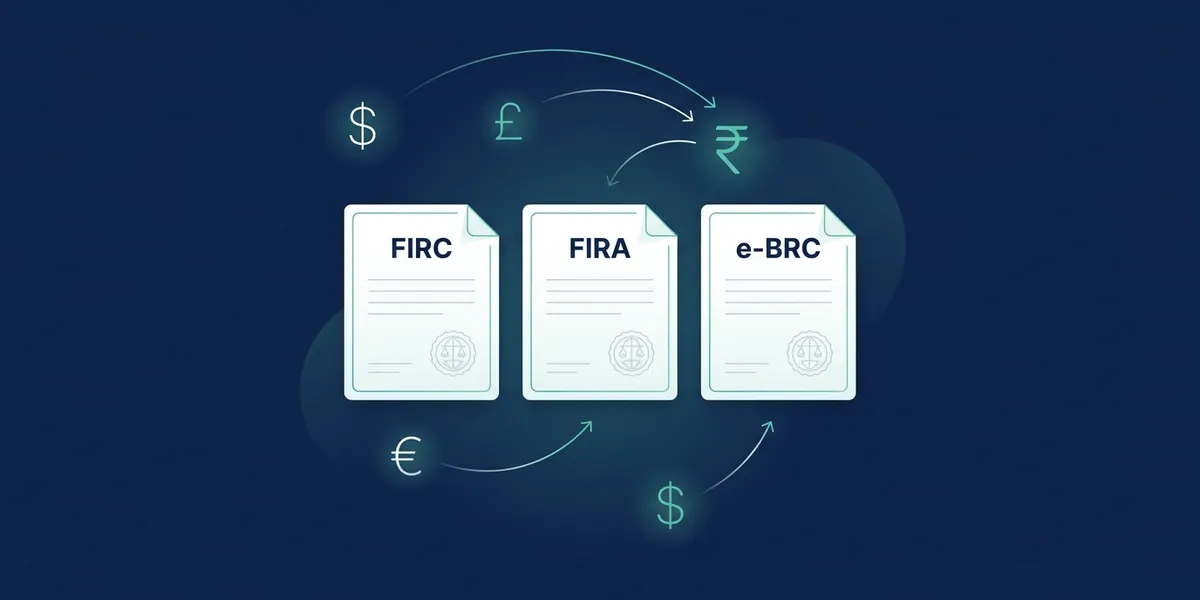
Four names float around whenever an exporter needs to prove that foreign money reached India: FIRC, e-FIRC, FIRA, and BRC (or e-BRC). They sound interchangeable, and people use them interchangeably — including banks and accountants. But they are different documents, issued by different institutions, for different purposes. Asking for the wrong one is why these requests bounce between you, your bank, and your CA for weeks.
This guide sorts it out once: what each document is, who issues it, when you need which one, and how to actually get your hands on it without chasing a forex desk.
The four documents, in one minute
FIRC (Foreign Inward Remittance Certificate) is the original: a physical certificate your bank issued as proof that a foreign payment arrived. Since 2016, banks have stopped issuing physical FIRCs for export payments. Today, the physical FIRC survives mainly for capital account transactions — foreign direct investment, share subscriptions, and similar inflows where a company must prove the source of foreign funds.
e-FIRC is the electronic record that replaced it for trade. When your bank receives an export-related inward remittance, it reports the transaction into the RBI's EDPMS (Export Data Processing and Monitoring System). That electronic entry — which your bank can generate a certificate against — is what most people mean by e-FIRC.
FIRA (Foreign Inward Remittance Advice) is the document service exporters and freelancers actually receive today. It is an advice — a statement issued by the bank or payment platform that received your money, recording who sent it, how much, in which currency, at what rate it was converted, and under which RBI purpose code. You will also hear it called e-FIRA. When your CA says "send me the FIRC" for a service export payment, this is almost always the document they need.
BRC / e-BRC (Bank Realisation Certificate) is a different animal. It is generated on the DGFT (Directorate General of Foreign Trade) portal and certifies that export proceeds against a specific shipping bill or invoice have been realised. Goods exporters need it to claim export incentives; it also supports GST refund claims for goods exports.

Why your bank says it "doesn't issue FIRC anymore"
In 2016, the RBI and FEDAI directed banks to stop issuing physical FIRCs for export transactions. The reasoning was straightforward: with EDPMS live, every export-related inward remittance was already being reported electronically, and a parallel paper trail invited duplication and misuse. Physical FIRCs were restricted to inflows that EDPMS does not track — primarily FDI and other capital account receipts.
The name, however, refused to die. A decade later, "FIRC" remains the colloquial term for any proof of inward remittance — which is why your CA asks for a FIRC, your bank says it doesn't issue FIRCs, and both are talking about the same thing: the remittance advice, or FIRA, that documents your payment.
So the practical translation rule is: for service exports, FIRC now effectively means FIRA. If you receive foreign equity investment into a company, you still need the formal FIRC from your AD bank.
FIRA: the document service exporters actually use
A FIRA is issued for each inward remittance by the institution that received it — your bank, or the payment platform that collected the money on your behalf. A complete FIRA records the remitter's name and country, the amount in foreign currency, the equivalent INR credited and the exchange rate applied, the date of credit, the UTR or transaction reference, and the RBI purpose code under which the payment was classified.
That single page does a lot of work. It is your proof of export realisation under FEMA. It supports the zero-rating of your export invoices under GST — whether you export under LUT or claim refunds on exports. It substantiates your foreign income in an income tax scrutiny. And it is the first document any auditor asks for when foreign receipts appear in your books.
The discipline that saves you later: for every international invoice, keep the invoice, the client contract or work order, and the FIRA together as one set. The FIRA is also what proves you met FEMA's export realisation deadline — and that deadline has moved twice in the past year, so it is worth getting the current position right.
As of July 2026, export proceeds — for goods, software, and services alike — must be realised within nine months. The RBI had extended the window to 15 months in November 2025, then reversed course and restored the nine-month limit from 5 June 2026 as a transitional measure. From 1 October 2026, the new FEMA (Export and Import) Regulations, 2026 take effect and bring back a 15-month window (18 months for exports invoiced in INR). If a client payment is running late against the current deadline, tell your bank before the window closes — extensions exist, but they need documentation and advance notice.
e-BRC: for exporters claiming benefits
The e-BRC lives on the DGFT portal, not at your bank, and it answers a different question. A FIRA says "money arrived." An e-BRC says "the proceeds of this specific export have been realised" — it links the payment back to a shipping bill or export invoice. That linkage is what schemes like duty drawback and RoDTEP check before paying out, which is why goods exporters claiming incentives need e-BRCs, not just remittance advices.
If you export services and claim no DGFT incentives, you will likely never need an e-BRC. Pure service exporters and freelancers can generally stop reading about it here — your world is the FIRA.
If you do need e-BRCs, note that the format changed on 13 January 2026. DGFT's revised Appendix 2U added mandatory GST fields — GSTIN, GST invoice number, and GST invoice date — and a QR code for online validation. Exporters now need invoice-level mapping between GST invoices, shipping bills, and inward remittances, which makes clean FIRA records upstream even more valuable. And since DGFT's system revamp, exporters self-certify e-BRCs on the portal against the remittance data their bank reports, rather than waiting on the bank to issue them.
Which document do you need? Match your situation
You freelance or run a service business and your CA wants proof of foreign income for GST or income tax: you need the FIRA for each payment, from whichever bank or platform received the money.
You are claiming a GST refund on exported services: the FIRA (or the bank's e-FIRC extract) is your proof of receipt in convertible foreign exchange — one of the five conditions that make a supply an export of services. Our guide to GST on foreign remittances walks through the full documentation set.
You export goods and claim duty drawback, RoDTEP, or advance authorisation benefits: you need e-BRCs generated on the DGFT portal against your shipping bills, in addition to the underlying remittance records.
Your company received foreign investment — equity, convertible instruments, or similar capital inflows: this is where the formal, physical FIRC still exists. Request it from the AD bank that received the funds; you will need it for RBI filings such as FC-GPR.
How to get your FIRA — and what it costs
Through a traditional bank, the process is a request to the branch or forex desk, usually in writing, with the UTR and credit details. Many banks charge a fee per certificate, and turnaround ranges from a couple of days to a couple of weeks depending on how often you follow up. If you receive a payment every month from three clients, that is thirty-six requests a year — a genuinely absurd amount of admin for a document generated from data the bank already holds.
Payment platforms handle this differently. With Winvesta's Global Collections Account, a digital FIRA is generated automatically for every payment you receive — at no charge — and is downloadable from your dashboard the moment funds are processed. Each FIRA carries the remitter details, amounts, rate, and purpose code your CA needs, so the month-end documentation chase simply disappears.

One caution regardless of route: check the purpose code on every FIRA when you receive it. A wrong code creates a mismatch between your invoice, your remittance record, and your tax filings — and correcting it months later means a letter to the bank, the UTR, and patience. If you are unsure which code applies to your work, start with our purpose code guides for exporters.
The vocabulary is messy because it accumulated over two decades of rule changes. The logic underneath is simple: FIRA proves money arrived, e-BRC proves an export was realised, and the old FIRC survives only for capital inflows. Match the document to the question being asked, and the paperwork stops being a mystery.
Disclaimer: The information provided in this blog is for general informational purposes only and does not constitute financial or legal advice. Winvesta makes no representations or warranties about the accuracy or suitability of the content and recommends consulting a professional before making any financial decisions.
Get paid globally. Keep more of it.
No FX markups. No GST. Funds in 1 day.

The payment from your US client landed on Tuesday. On Wednesday, your CA asked for the FIRC. On Thursday, your bank told you they don't issue FIRCs anymore. Welcome to one of the most confusing corners of Indian export paperwork.
Four names float around whenever an exporter needs to prove that foreign money reached India: FIRC, e-FIRC, FIRA, and BRC (or e-BRC). They sound interchangeable, and people use them interchangeably — including banks and accountants. But they are different documents, issued by different institutions, for different purposes. Asking for the wrong one is why these requests bounce between you, your bank, and your CA for weeks.
This guide sorts it out once: what each document is, who issues it, when you need which one, and how to actually get your hands on it without chasing a forex desk.
The four documents, in one minute
FIRC (Foreign Inward Remittance Certificate) is the original: a physical certificate your bank issued as proof that a foreign payment arrived. Since 2016, banks have stopped issuing physical FIRCs for export payments. Today, the physical FIRC survives mainly for capital account transactions — foreign direct investment, share subscriptions, and similar inflows where a company must prove the source of foreign funds.
e-FIRC is the electronic record that replaced it for trade. When your bank receives an export-related inward remittance, it reports the transaction into the RBI's EDPMS (Export Data Processing and Monitoring System). That electronic entry — which your bank can generate a certificate against — is what most people mean by e-FIRC.
FIRA (Foreign Inward Remittance Advice) is the document service exporters and freelancers actually receive today. It is an advice — a statement issued by the bank or payment platform that received your money, recording who sent it, how much, in which currency, at what rate it was converted, and under which RBI purpose code. You will also hear it called e-FIRA. When your CA says "send me the FIRC" for a service export payment, this is almost always the document they need.
BRC / e-BRC (Bank Realisation Certificate) is a different animal. It is generated on the DGFT (Directorate General of Foreign Trade) portal and certifies that export proceeds against a specific shipping bill or invoice have been realised. Goods exporters need it to claim export incentives; it also supports GST refund claims for goods exports.
Why your bank says it "doesn't issue FIRC anymore"
In 2016, the RBI and FEDAI directed banks to stop issuing physical FIRCs for export transactions. The reasoning was straightforward: with EDPMS live, every export-related inward remittance was already being reported electronically, and a parallel paper trail invited duplication and misuse. Physical FIRCs were restricted to inflows that EDPMS does not track — primarily FDI and other capital account receipts.
The name, however, refused to die. A decade later, "FIRC" remains the colloquial term for any proof of inward remittance — which is why your CA asks for a FIRC, your bank says it doesn't issue FIRCs, and both are talking about the same thing: the remittance advice, or FIRA, that documents your payment.
So the practical translation rule is: for service exports, FIRC now effectively means FIRA. If you receive foreign equity investment into a company, you still need the formal FIRC from your AD bank.
FIRA: the document service exporters actually use
A FIRA is issued for each inward remittance by the institution that received it — your bank, or the payment platform that collected the money on your behalf. A complete FIRA records the remitter's name and country, the amount in foreign currency, the equivalent INR credited and the exchange rate applied, the date of credit, the UTR or transaction reference, and the RBI purpose code under which the payment was classified.
That single page does a lot of work. It is your proof of export realisation under FEMA. It supports the zero-rating of your export invoices under GST — whether you export under LUT or claim refunds on exports. It substantiates your foreign income in an income tax scrutiny. And it is the first document any auditor asks for when foreign receipts appear in your books.
The discipline that saves you later: for every international invoice, keep the invoice, the client contract or work order, and the FIRA together as one set. The FIRA is also what proves you met FEMA's export realisation deadline — and that deadline has moved twice in the past year, so it is worth getting the current position right.
As of July 2026, export proceeds — for goods, software, and services alike — must be realised within nine months. The RBI had extended the window to 15 months in November 2025, then reversed course and restored the nine-month limit from 5 June 2026 as a transitional measure. From 1 October 2026, the new FEMA (Export and Import) Regulations, 2026 take effect and bring back a 15-month window (18 months for exports invoiced in INR). If a client payment is running late against the current deadline, tell your bank before the window closes — extensions exist, but they need documentation and advance notice.
e-BRC: for exporters claiming benefits
The e-BRC lives on the DGFT portal, not at your bank, and it answers a different question. A FIRA says "money arrived." An e-BRC says "the proceeds of this specific export have been realised" — it links the payment back to a shipping bill or export invoice. That linkage is what schemes like duty drawback and RoDTEP check before paying out, which is why goods exporters claiming incentives need e-BRCs, not just remittance advices.
If you export services and claim no DGFT incentives, you will likely never need an e-BRC. Pure service exporters and freelancers can generally stop reading about it here — your world is the FIRA.
If you do need e-BRCs, note that the format changed on 13 January 2026. DGFT's revised Appendix 2U added mandatory GST fields — GSTIN, GST invoice number, and GST invoice date — and a QR code for online validation. Exporters now need invoice-level mapping between GST invoices, shipping bills, and inward remittances, which makes clean FIRA records upstream even more valuable. And since DGFT's system revamp, exporters self-certify e-BRCs on the portal against the remittance data their bank reports, rather than waiting on the bank to issue them.
Which document do you need? Match your situation
You freelance or run a service business and your CA wants proof of foreign income for GST or income tax: you need the FIRA for each payment, from whichever bank or platform received the money.
You are claiming a GST refund on exported services: the FIRA (or the bank's e-FIRC extract) is your proof of receipt in convertible foreign exchange — one of the five conditions that make a supply an export of services. Our guide to GST on foreign remittances walks through the full documentation set.
You export goods and claim duty drawback, RoDTEP, or advance authorisation benefits: you need e-BRCs generated on the DGFT portal against your shipping bills, in addition to the underlying remittance records.
Your company received foreign investment — equity, convertible instruments, or similar capital inflows: this is where the formal, physical FIRC still exists. Request it from the AD bank that received the funds; you will need it for RBI filings such as FC-GPR.
How to get your FIRA — and what it costs
Through a traditional bank, the process is a request to the branch or forex desk, usually in writing, with the UTR and credit details. Many banks charge a fee per certificate, and turnaround ranges from a couple of days to a couple of weeks depending on how often you follow up. If you receive a payment every month from three clients, that is thirty-six requests a year — a genuinely absurd amount of admin for a document generated from data the bank already holds.
Payment platforms handle this differently. With Winvesta's Global Collections Account, a digital FIRA is generated automatically for every payment you receive — at no charge — and is downloadable from your dashboard the moment funds are processed. Each FIRA carries the remitter details, amounts, rate, and purpose code your CA needs, so the month-end documentation chase simply disappears.
One caution regardless of route: check the purpose code on every FIRA when you receive it. A wrong code creates a mismatch between your invoice, your remittance record, and your tax filings — and correcting it months later means a letter to the bank, the UTR, and patience. If you are unsure which code applies to your work, start with our purpose code guides for exporters.
The vocabulary is messy because it accumulated over two decades of rule changes. The logic underneath is simple: FIRA proves money arrived, e-BRC proves an export was realised, and the old FIRC survives only for capital inflows. Match the document to the question being asked, and the paperwork stops being a mystery.
Disclaimer: The information provided in this blog is for general informational purposes only and does not constitute financial or legal advice. Winvesta makes no representations or warranties about the accuracy or suitability of the content and recommends consulting a professional before making any financial decisions.
Get paid globally. Keep more of it.
No FX markups. No GST. Funds in 1 day.