Wall Street's great divide: Inflation fears clash with tech's relentless rally
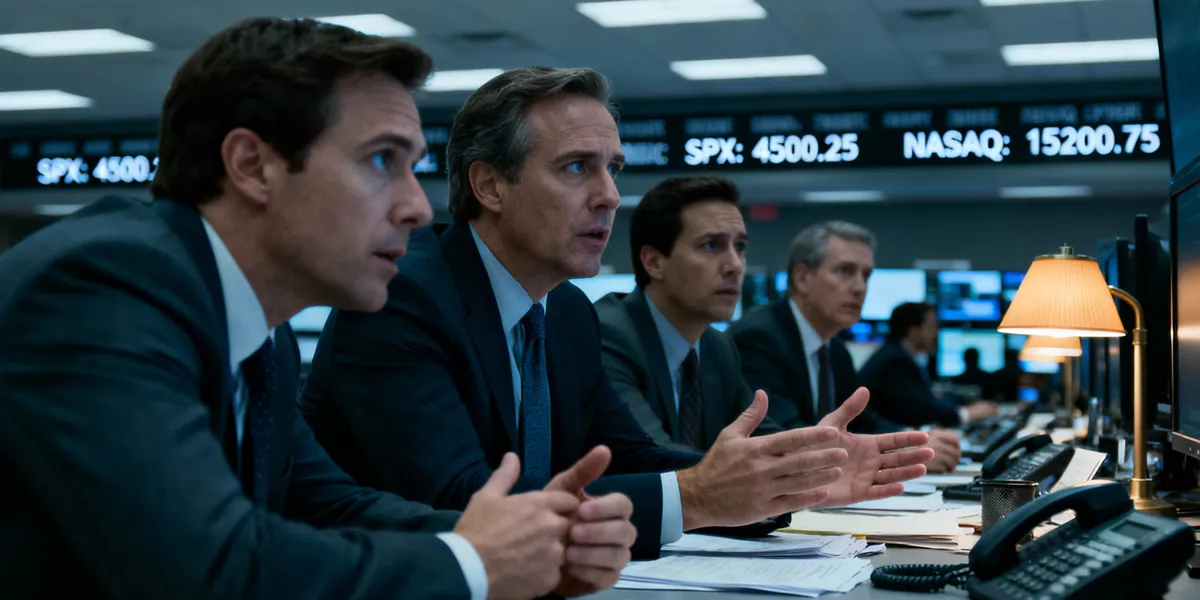
The trading floor felt like a study in contrasts today, a place of two minds operating in a single body. In one corner, furrowed brows and hushed conversations centred on the latest inflation figures, which landed with the unwelcome thud of a problem that refuses to go away. In the other, a palpable excitement buzzed around a handful of technology behemoths, whose share prices seemed to exist in a different reality altogether, one defined by silicon chips and artificial intelligence rather than consumer price indices. This split personality has come to define the US market in recent weeks, as investors grapple with a complex and often contradictory set of signals. The Dow Jones Industrial Average finished the day modestly lower by 0.4%, or about 150 points, while the broader S&P 500 clung to a fractional gain. The tech-heavy Nasdaq Composite, however, told a different story, closing up a robust 0.8%, underscoring the great divergence that is currently steering market sentiment and capital flows.

The stubborn spectre of inflation
The main source of anxiety today stems from the Producer Price Index (PPI) report, a measure of inflation at the wholesale level. The figures for last month came in hotter than economists had anticipated, showing a 0.5% month-on-month increase against a forecast of 0.3%. While one data point does not make a trend, it follows a recent Consumer Price Index (CPI) reading that also proved stickier than hoped for. This persistence of price pressures has poured cold water on the market's earlier, more exuberant expectations for a series of interest rate cuts from the U.S. Federal Reserve this year. The dream of a smooth and rapid return to the central bank's 2% inflation target is being replaced by the grinding reality of a long and bumpy final mile. The CME FedWatch Tool, which gauges market expectations for rate movements, saw the probability of a September rate cut dip below 50% following the report's release, a significant shift from just a few weeks ago when it was considered almost a certainty.
This has immediate consequences for the bond market, where yields on government debt are a key barometer of interest rate expectations. The yield on the 10-year Treasury note, a benchmark for everything from mortgage rates to corporate borrowing costs, ticked higher to 4.55%. This upward creep in yields puts pressure on stock valuations, particularly for companies in interest-rate-sensitive sectors like utilities, real estate, and consumer staples.

Shares in companies like Procter & Gamble and NextEra Energy saw modest declines as investors recalculated the appeal of their stable dividends against the rising returns offered by less risky government bonds. The sentiment was summed up by commentary from a leading economist.
"We're seeing clear evidence that the path back to stable prices is not a straight line. The Fed has indicated its data-dependent stance, and this morning's data gives them very little reason to contemplate easing policy. The market is having to digest the idea that 'higher for longer' isn't just a slogan; it might be the baseline scenario for the rest of the year," says Ellen Zentner, Chief U.S. Economist at Morgan Stanley.
The unease was also reflected in the performance of consumer-focused companies. Retail giant Target saw its shares dip nearly 2% after a competitor issued a cautious outlook on consumer spending, citing wallet-conscious shoppers who are prioritising necessities over discretionary goods. This adds another layer of complexity for the Fed; if they keep rates high to fight inflation, they risk slowing the economy too much and hurting the very consumer that accounts for two-thirds of U.S. economic activity. It’s a delicate balancing act, and today’s data simply made the tightrope seem even higher.
Technology's Bullish Isolation
Yet, to walk from the metaphorical corner of the trading floor, worrying about inflation, to the one celebrating technology was to enter another world. Here, the macroeconomic headwinds seemed like a distant storm, obscured by the towering presence of the artificial intelligence boom. The Nasdaq's outperformance was almost entirely a function of a few key names that continue to captivate the market's imagination and attract a torrent of investment. At the forefront was Nvidia, the chipmaker whose hardware underpins the entire AI movement. Its shares surged another 3.1% to reach a new all-time high, with its market capitalisation swelling to astronomical levels. The company's upcoming earnings report is now one of the most keenly anticipated events on the entire market calendar, seen as a referendum on the health of the entire AI spending cycle.
It wasn't just Nvidia. Microsoft, heavily invested in OpenAI, gained 1.2%, while Apple saw its shares rise 1.5% as excitement continued to build around the AI-focused features expected in its next generation of software and devices. This concentration of gains in a small number of mega-cap tech stocks has been a defining feature of the 2024 rally. These companies possess fortress-like balance sheets, immense cash flows, and a narrative of structural expansion that appears, for now, to be insulated from the vagaries of interest rate policy and consumer sentiment. While the average stock in the S&P 500 may be struggling, the sheer weight of these giants is enough to keep the overall index afloat and moving higher.
"The AI theme is a secular tidal wave, and Wall Street is trying to get in front of it. While the rest of the market is rightly concerned about the Fed and inflation, the spending we're seeing on AI infrastructure is on a different trajectory. It's a non-discretionary spending cycle for many corporations, and investors are paying a premium to own the primary beneficiaries of this build-out," notes Dan Ives, Managing Director at Wedbush Securities.
This dynamic, however, presents its own set of risks. A market rally that is so narrowly led is often considered less healthy than a broad-based advance. It suggests that conviction is high among a few winners, but low across the wider economy. If anything were to derail the AI narrative—be it a disappointing earnings report from a key player or signs of a spending slowdown—the market would be left without its primary support. For now, though, that concern remains on the back burner. The story of technology’s unshakeable resolve in the face of economic uncertainty continues, leaving Wall Street a house divided, with one foot planted firmly in the worries of today and the other striding confidently into a silicon-powered tomorrow.
Disclaimer: The views and recommendations made above are those of individual analysts or brokerage companies, and not of Winvesta. We advise investors to check with certified experts before making any investment decisions.
Ready to earn on every trade?
Invest in 11,000+ US stocks & ETFs

Table of Contents
The trading floor felt like a study in contrasts today, a place of two minds operating in a single body. In one corner, furrowed brows and hushed conversations centred on the latest inflation figures, which landed with the unwelcome thud of a problem that refuses to go away. In the other, a palpable excitement buzzed around a handful of technology behemoths, whose share prices seemed to exist in a different reality altogether, one defined by silicon chips and artificial intelligence rather than consumer price indices. This split personality has come to define the US market in recent weeks, as investors grapple with a complex and often contradictory set of signals. The Dow Jones Industrial Average finished the day modestly lower by 0.4%, or about 150 points, while the broader S&P 500 clung to a fractional gain. The tech-heavy Nasdaq Composite, however, told a different story, closing up a robust 0.8%, underscoring the great divergence that is currently steering market sentiment and capital flows.
The stubborn spectre of inflation
The main source of anxiety today stems from the Producer Price Index (PPI) report, a measure of inflation at the wholesale level. The figures for last month came in hotter than economists had anticipated, showing a 0.5% month-on-month increase against a forecast of 0.3%. While one data point does not make a trend, it follows a recent Consumer Price Index (CPI) reading that also proved stickier than hoped for. This persistence of price pressures has poured cold water on the market's earlier, more exuberant expectations for a series of interest rate cuts from the U.S. Federal Reserve this year. The dream of a smooth and rapid return to the central bank's 2% inflation target is being replaced by the grinding reality of a long and bumpy final mile. The CME FedWatch Tool, which gauges market expectations for rate movements, saw the probability of a September rate cut dip below 50% following the report's release, a significant shift from just a few weeks ago when it was considered almost a certainty.
This has immediate consequences for the bond market, where yields on government debt are a key barometer of interest rate expectations. The yield on the 10-year Treasury note, a benchmark for everything from mortgage rates to corporate borrowing costs, ticked higher to 4.55%. This upward creep in yields puts pressure on stock valuations, particularly for companies in interest-rate-sensitive sectors like utilities, real estate, and consumer staples.
Shares in companies like Procter & Gamble and NextEra Energy saw modest declines as investors recalculated the appeal of their stable dividends against the rising returns offered by less risky government bonds. The sentiment was summed up by commentary from a leading economist.
"We're seeing clear evidence that the path back to stable prices is not a straight line. The Fed has indicated its data-dependent stance, and this morning's data gives them very little reason to contemplate easing policy. The market is having to digest the idea that 'higher for longer' isn't just a slogan; it might be the baseline scenario for the rest of the year," says Ellen Zentner, Chief U.S. Economist at Morgan Stanley.
The unease was also reflected in the performance of consumer-focused companies. Retail giant Target saw its shares dip nearly 2% after a competitor issued a cautious outlook on consumer spending, citing wallet-conscious shoppers who are prioritising necessities over discretionary goods. This adds another layer of complexity for the Fed; if they keep rates high to fight inflation, they risk slowing the economy too much and hurting the very consumer that accounts for two-thirds of U.S. economic activity. It’s a delicate balancing act, and today’s data simply made the tightrope seem even higher.
Technology's Bullish Isolation
Yet, to walk from the metaphorical corner of the trading floor, worrying about inflation, to the one celebrating technology was to enter another world. Here, the macroeconomic headwinds seemed like a distant storm, obscured by the towering presence of the artificial intelligence boom. The Nasdaq's outperformance was almost entirely a function of a few key names that continue to captivate the market's imagination and attract a torrent of investment. At the forefront was Nvidia, the chipmaker whose hardware underpins the entire AI movement. Its shares surged another 3.1% to reach a new all-time high, with its market capitalisation swelling to astronomical levels. The company's upcoming earnings report is now one of the most keenly anticipated events on the entire market calendar, seen as a referendum on the health of the entire AI spending cycle.
It wasn't just Nvidia. Microsoft, heavily invested in OpenAI, gained 1.2%, while Apple saw its shares rise 1.5% as excitement continued to build around the AI-focused features expected in its next generation of software and devices. This concentration of gains in a small number of mega-cap tech stocks has been a defining feature of the 2024 rally. These companies possess fortress-like balance sheets, immense cash flows, and a narrative of structural expansion that appears, for now, to be insulated from the vagaries of interest rate policy and consumer sentiment. While the average stock in the S&P 500 may be struggling, the sheer weight of these giants is enough to keep the overall index afloat and moving higher.
"The AI theme is a secular tidal wave, and Wall Street is trying to get in front of it. While the rest of the market is rightly concerned about the Fed and inflation, the spending we're seeing on AI infrastructure is on a different trajectory. It's a non-discretionary spending cycle for many corporations, and investors are paying a premium to own the primary beneficiaries of this build-out," notes Dan Ives, Managing Director at Wedbush Securities.
This dynamic, however, presents its own set of risks. A market rally that is so narrowly led is often considered less healthy than a broad-based advance. It suggests that conviction is high among a few winners, but low across the wider economy. If anything were to derail the AI narrative—be it a disappointing earnings report from a key player or signs of a spending slowdown—the market would be left without its primary support. For now, though, that concern remains on the back burner. The story of technology’s unshakeable resolve in the face of economic uncertainty continues, leaving Wall Street a house divided, with one foot planted firmly in the worries of today and the other striding confidently into a silicon-powered tomorrow.
Disclaimer: The views and recommendations made above are those of individual analysts or brokerage companies, and not of Winvesta. We advise investors to check with certified experts before making any investment decisions.
Ready to earn on every trade?
Invest in 11,000+ US stocks & ETFs


