How to read stock charts: Candlestick graphs and patterns for beginners

Charts make stock market data easier to digest—but not all charts are created equal. While line graphs show trends over time, they often miss key details. A candlestick graph, on the other hand, gives you a fuller picture with just a glance. It’s colorful, compact, and captures more data in a single visual—perfect for anyone who doesn’t want to squint at spreadsheets.
If you're just starting out, though, even a candlestick graph can feel overwhelming. Words like “wicks,” “engulfing,” or “doji” pop up, and suddenly, it all starts to sound like another language. Add in other options like bar charts, line charts, and volume overlays, and it’s easy to wonder: Which one should I even use—and how?
That’s where this blog steps in. We’ll walk you through exactly what a candlestick graph is, what it shows, and how to read it. You’ll learn the meaning behind common candlestick patterns and what they might signal about a stock’s next move. We'll also explain when a candle chart is more useful than other chart types, especially for short-term trades or spotting reversals.
Whether you’re reading a daily stock candle chart or watching a 5-minute candle graph stock for intraday moves, this guide will make those flickering boxes on your screen a lot more meaningful. Let’s make stock visuals less confusing—and way more useful—for you.
Understanding what candlestick graphs show you
What is a candlestick graph?
A candlestick graph is a type of financial chart that shows how a stock’s price has moved during a specific time period. It’s built from individual “candles” that each represent price action over that duration—whether it’s 1 minute, 1 hour, or 1 day. This style of candle chart helps traders see overall market direction and momentum quickly, just by looking at shapes and colors.
Unlike a line chart, which only tracks closing prices, a candlestick graph shows four key data points: the opening price, the closing price, the highest point, and the lowest point within that time frame. This extra detail makes it much easier to understand not just where the price is, but how it got there.
The anatomy of a candle
Each candle has two parts: the “body” and the “wicks” (also called shadows). The body shows the range between the stock’s open and close prices during that time slot. The wicks show the highest and lowest prices reached.
If the stock closed higher than it opened, the body is typically green or white—this is called a bullish candle. If the stock closed lower, the body is red or black—this is a bearish candle.
- Strong price movement
- Little price movement—possible indecision
- Price tested extremes but didn’t stay there
This visual setup turns one candle into a mini-story of market behaviour for that time slot.
Timeframes and what each candle represents
Candlesticks can be viewed in any timeframe, and each candle reflects price data from that period. A 1-minute candle chart shows rapid movements; a daily candle graph shows broader trends.
For example, a trader looking for quick intraday opportunities might use a 5-minute candle chart to catch entries and exits. On the other hand, a long-term investor might prefer a weekly or monthly chart to spot larger trends.
Your choice of timeframe depends on your trading style. But regardless of the length, each candle always includes the same four price points—open, high, low, and close.
Once you understand this structure, you’ll be ready to start reading patterns—and that’s where the real power of candlesticks begins.
Decoding popular candlestick patterns
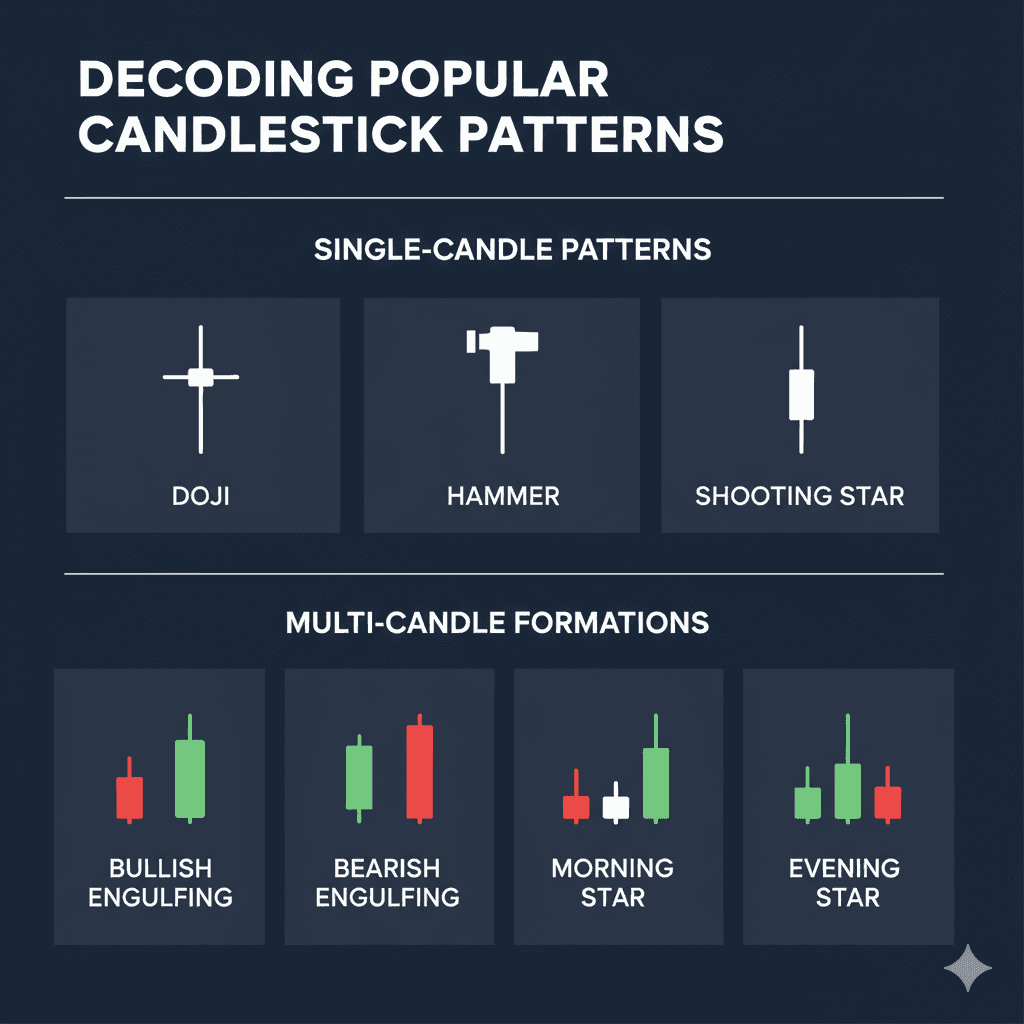
Single-candle patterns to recognize
Once you're familiar with how each candle in a candle graph is built, the next step is spotting simple patterns. These single-candle formations can often signal shifts in momentum or trend direction.
Here are a few you’ll see often:
- Doji: The open and close prices are nearly the same, forming a cross-like shape. It shows indecision in the market.
- Hammer: A short body at the top with a long lower wick. It may signal a reversal after a downtrend.
- Shooting star: Opposite of a hammer, found at the top of an uptrend. A small body with a long upper wick, suggesting a possible bearish reversal.
These single-candle signs don’t give trading signals alone, but they’re a great starting point for reading market sentiment in a candle graph.
Multi-candle formations and their meaning
When you combine two or three candles, the patterns get more powerful. These formations are commonly used by traders to identify trend reversals and entry points.
- Bullish engulfing: A small red candle followed by a large green one that fully covers it. It can indicate the start of an uptrend.
- Bearish engulfing: A large red candle follows a smaller green one and covers it. This often shows selling pressure entering the market.
- Morning star: A three-candle pattern—strong red, small-bodied (indecisive), then strong green. It suggests a reversal from bearish to bullish.
- Evening star: The opposite of the morning star, hinting at a move downward.
These combos help you make better decisions by putting price action into context over multiple time slots.
Practice spotting patterns in real charts
The best way to get familiar with these formations is to look at a real candle graph stock chart. Try pulling up charts for companies like Apple, TCS, or Reliance and switching to daily or hourly views.
As you scroll through the chart, look for the shapes and sequences mentioned earlier. Ask yourself questions like: Is this hammer in a downtrend? Did a bullish engulfing appear at a previous support level?
Pattern recognition takes practice. But the more examples you study, the faster you’ll develop confidence when reading a candle bar chart. And with patterns in mind, you’ll be better prepared to spot real trade setups—which we’ll dive into next.
Why candlestick patterns matter for new traders
Visual storytelling of market psychology
A candle bar chart isn’t just a series of shapes—it’s a visual summary of trader emotions. Fear, greed, hesitation, and conviction all show up in the candles. When a long red candle follows several small green ones, it often points to panic selling. A doji after a strong trend may signal doubt setting in among traders.
This kind of psychological insight is hard to get from a regular line chart. Candlestick graphs let you visually "read the room" of the market. That’s crucial for beginners who need quick ways to gauge sentiment without digging into complex indicators.
By studying these signals on a candle bar chart, you start to understand how buyers and sellers behave around key support or resistance levels.
Quick decision-making with price action
Many beginners get stuck waiting for confirmation from lagging indicators like RSI or MACD. But a candle chart gives immediate clues through price action itself. A bullish engulfing near a 200-day moving average? That’s a fast and clear sign to pay attention.
Because each candle reflects pure price movement, you can interpret signals without relying on extra tools. This makes candlestick charts ideal for short-term traders or anyone making quick decisions—think swing trades or intraday setups.
For example, if you're day trading a stock like Infosys or PayPal, spotting a hammer on a 15-minute candle bar chart could help you time your entry better than using delayed technical indicators.
Helps develop disciplined trading habits
Relying on clear, repeatable patterns makes it easier to stick to a trading plan. Beginners often struggle with impulsive buys and panic sells. But using defined setups from a stock candle chart—like waiting for a morning star near support—builds good habits.
Over time, you'll start to log trades by pattern type, success rate, and timeframe. This pattern-based approach turns your trading into a process rather than a guess. And because you’re watching the same price signals many professionals use, you’ll avoid many rookie mistakes.
In the next section, we’ll look at how candle plots compare to other chart types—and when to choose them for better trading visibility.
When to choose candlestick graphs over other charts
Comparing common chart types
Not all stock charts are created equal. Line charts plot closing prices over time with a simple curve, which gives you a general sense of price direction. Bar charts include more detail—like opening and closing prices—but are harder to read at a glance.
A candle plot combines readability and detail. Each "candle" shows the open, high, low, and close, plus directional movement through color. That makes the candlestick graph more intuitive than a bar chart and more informative than a line chart.
If you're scanning for entry points during volatile markets, line charts might miss turning points. Bar charts may show them, but they’re less visual. A candle graph stock display helps you quickly spot key signals like reversals or indecision candles without extra analysis.
Best scenarios for using candle plots
Candlestick graphs are best when you're watching for short-term price shifts. If you're swing trading or day trading, a 5-minute or hourly candle plot tells you when momentum is building—or slowing down.
They're also useful when you want to confirm trend strength. For example, if Apple breaks resistance and follows up with multiple green candles and higher lows, that stock candle chart gives instant confirmation of buyer interest. You get both price level and momentum.
- Use candle plots for timing trades based on patterns (e.g., hammer, engulfing)
- Prefer them over line charts for visualizing volatility
- Choose them over bar charts when you need faster interpretation
As a beginner, using a candle graph can simplify your decision-making without sacrificing context. In the FAQs below, we’ll answer some common questions new traders ask about this chart type.
Disclaimer: The views and recommendations made above are those of individual analysts or brokerage companies, and not of Winvesta. We advise investors to check with certified experts before making any investment decisions.
Ready to earn on every trade?
Invest in 11,000+ US stocks & ETFs

Charts make stock market data easier to digest—but not all charts are created equal. While line graphs show trends over time, they often miss key details. A candlestick graph, on the other hand, gives you a fuller picture with just a glance. It’s colorful, compact, and captures more data in a single visual—perfect for anyone who doesn’t want to squint at spreadsheets.
If you're just starting out, though, even a candlestick graph can feel overwhelming. Words like “wicks,” “engulfing,” or “doji” pop up, and suddenly, it all starts to sound like another language. Add in other options like bar charts, line charts, and volume overlays, and it’s easy to wonder: Which one should I even use—and how?
That’s where this blog steps in. We’ll walk you through exactly what a candlestick graph is, what it shows, and how to read it. You’ll learn the meaning behind common candlestick patterns and what they might signal about a stock’s next move. We'll also explain when a candle chart is more useful than other chart types, especially for short-term trades or spotting reversals.
Whether you’re reading a daily stock candle chart or watching a 5-minute candle graph stock for intraday moves, this guide will make those flickering boxes on your screen a lot more meaningful. Let’s make stock visuals less confusing—and way more useful—for you.
Understanding what candlestick graphs show you
What is a candlestick graph?
A candlestick graph is a type of financial chart that shows how a stock’s price has moved during a specific time period. It’s built from individual “candles” that each represent price action over that duration—whether it’s 1 minute, 1 hour, or 1 day. This style of candle chart helps traders see overall market direction and momentum quickly, just by looking at shapes and colors.
Unlike a line chart, which only tracks closing prices, a candlestick graph shows four key data points: the opening price, the closing price, the highest point, and the lowest point within that time frame. This extra detail makes it much easier to understand not just where the price is, but how it got there.
The anatomy of a candle
Each candle has two parts: the “body” and the “wicks” (also called shadows). The body shows the range between the stock’s open and close prices during that time slot. The wicks show the highest and lowest prices reached.
If the stock closed higher than it opened, the body is typically green or white—this is called a bullish candle. If the stock closed lower, the body is red or black—this is a bearish candle.
- Strong price movement
- Little price movement—possible indecision
- Price tested extremes but didn’t stay there
This visual setup turns one candle into a mini-story of market behaviour for that time slot.
Timeframes and what each candle represents
Candlesticks can be viewed in any timeframe, and each candle reflects price data from that period. A 1-minute candle chart shows rapid movements; a daily candle graph shows broader trends.
For example, a trader looking for quick intraday opportunities might use a 5-minute candle chart to catch entries and exits. On the other hand, a long-term investor might prefer a weekly or monthly chart to spot larger trends.
Your choice of timeframe depends on your trading style. But regardless of the length, each candle always includes the same four price points—open, high, low, and close.
Once you understand this structure, you’ll be ready to start reading patterns—and that’s where the real power of candlesticks begins.
Decoding popular candlestick patterns
Single-candle patterns to recognize
Once you're familiar with how each candle in a candle graph is built, the next step is spotting simple patterns. These single-candle formations can often signal shifts in momentum or trend direction.
Here are a few you’ll see often:
- Doji: The open and close prices are nearly the same, forming a cross-like shape. It shows indecision in the market.
- Hammer: A short body at the top with a long lower wick. It may signal a reversal after a downtrend.
- Shooting star: Opposite of a hammer, found at the top of an uptrend. A small body with a long upper wick, suggesting a possible bearish reversal.
These single-candle signs don’t give trading signals alone, but they’re a great starting point for reading market sentiment in a candle graph.
Multi-candle formations and their meaning
When you combine two or three candles, the patterns get more powerful. These formations are commonly used by traders to identify trend reversals and entry points.
- Bullish engulfing: A small red candle followed by a large green one that fully covers it. It can indicate the start of an uptrend.
- Bearish engulfing: A large red candle follows a smaller green one and covers it. This often shows selling pressure entering the market.
- Morning star: A three-candle pattern—strong red, small-bodied (indecisive), then strong green. It suggests a reversal from bearish to bullish.
- Evening star: The opposite of the morning star, hinting at a move downward.
These combos help you make better decisions by putting price action into context over multiple time slots.
Practice spotting patterns in real charts
The best way to get familiar with these formations is to look at a real candle graph stock chart. Try pulling up charts for companies like Apple, TCS, or Reliance and switching to daily or hourly views.
As you scroll through the chart, look for the shapes and sequences mentioned earlier. Ask yourself questions like: Is this hammer in a downtrend? Did a bullish engulfing appear at a previous support level?
Pattern recognition takes practice. But the more examples you study, the faster you’ll develop confidence when reading a candle bar chart. And with patterns in mind, you’ll be better prepared to spot real trade setups—which we’ll dive into next.
Why candlestick patterns matter for new traders
Visual storytelling of market psychology
A candle bar chart isn’t just a series of shapes—it’s a visual summary of trader emotions. Fear, greed, hesitation, and conviction all show up in the candles. When a long red candle follows several small green ones, it often points to panic selling. A doji after a strong trend may signal doubt setting in among traders.
This kind of psychological insight is hard to get from a regular line chart. Candlestick graphs let you visually "read the room" of the market. That’s crucial for beginners who need quick ways to gauge sentiment without digging into complex indicators.
By studying these signals on a candle bar chart, you start to understand how buyers and sellers behave around key support or resistance levels.
Quick decision-making with price action
Many beginners get stuck waiting for confirmation from lagging indicators like RSI or MACD. But a candle chart gives immediate clues through price action itself. A bullish engulfing near a 200-day moving average? That’s a fast and clear sign to pay attention.
Because each candle reflects pure price movement, you can interpret signals without relying on extra tools. This makes candlestick charts ideal for short-term traders or anyone making quick decisions—think swing trades or intraday setups.
For example, if you're day trading a stock like Infosys or PayPal, spotting a hammer on a 15-minute candle bar chart could help you time your entry better than using delayed technical indicators.
Helps develop disciplined trading habits
Relying on clear, repeatable patterns makes it easier to stick to a trading plan. Beginners often struggle with impulsive buys and panic sells. But using defined setups from a stock candle chart—like waiting for a morning star near support—builds good habits.
Over time, you'll start to log trades by pattern type, success rate, and timeframe. This pattern-based approach turns your trading into a process rather than a guess. And because you’re watching the same price signals many professionals use, you’ll avoid many rookie mistakes.
In the next section, we’ll look at how candle plots compare to other chart types—and when to choose them for better trading visibility.
When to choose candlestick graphs over other charts
Comparing common chart types
Not all stock charts are created equal. Line charts plot closing prices over time with a simple curve, which gives you a general sense of price direction. Bar charts include more detail—like opening and closing prices—but are harder to read at a glance.
A candle plot combines readability and detail. Each "candle" shows the open, high, low, and close, plus directional movement through color. That makes the candlestick graph more intuitive than a bar chart and more informative than a line chart.
If you're scanning for entry points during volatile markets, line charts might miss turning points. Bar charts may show them, but they’re less visual. A candle graph stock display helps you quickly spot key signals like reversals or indecision candles without extra analysis.
Best scenarios for using candle plots
Candlestick graphs are best when you're watching for short-term price shifts. If you're swing trading or day trading, a 5-minute or hourly candle plot tells you when momentum is building—or slowing down.
They're also useful when you want to confirm trend strength. For example, if Apple breaks resistance and follows up with multiple green candles and higher lows, that stock candle chart gives instant confirmation of buyer interest. You get both price level and momentum.
- Use candle plots for timing trades based on patterns (e.g., hammer, engulfing)
- Prefer them over line charts for visualizing volatility
- Choose them over bar charts when you need faster interpretation
As a beginner, using a candle graph can simplify your decision-making without sacrificing context. In the FAQs below, we’ll answer some common questions new traders ask about this chart type.
Disclaimer: The views and recommendations made above are those of individual analysts or brokerage companies, and not of Winvesta. We advise investors to check with certified experts before making any investment decisions.
Ready to earn on every trade?
Invest in 11,000+ US stocks & ETFs


