Client paid in full but you received less? Where the money went and what to do
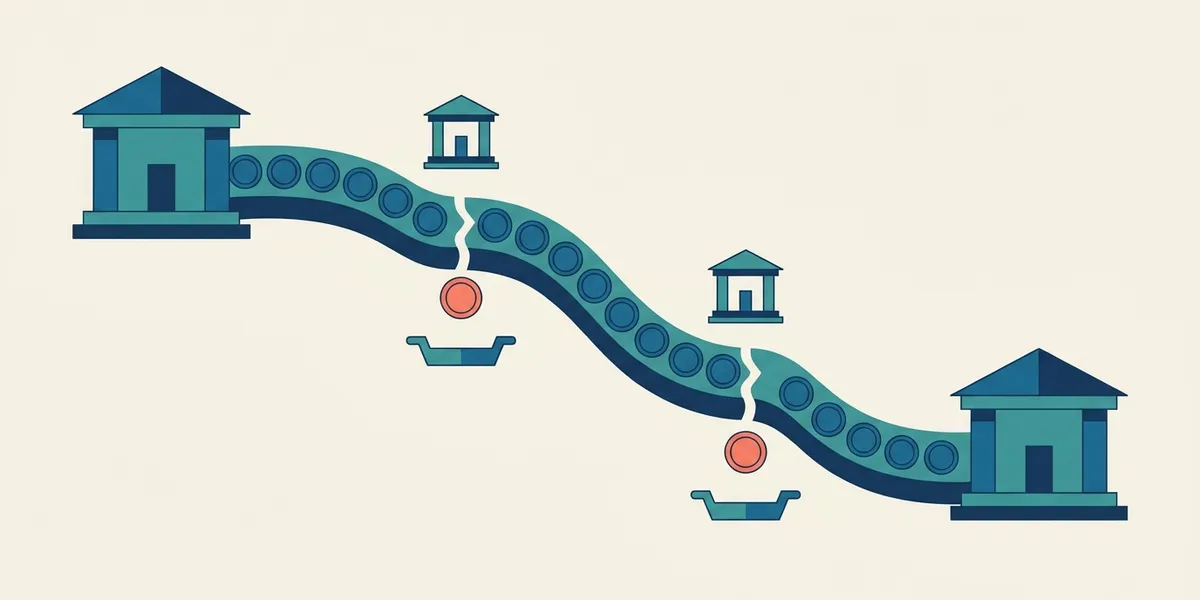
You invoiced a client in Rotterdam for USD 3,000. Their finance team sends the remittance advice: USD 3,000, paid in full. Two days later your bank credits USD 2,965. Nobody on either side chose to give away 35 dollars, and nobody can tell you straight away where it went.
It is one of the most common things service exporters ask about after their first few international payments. The gap is rarely a mistake. It is usually a fee taken while the money was in transit, and the instruction that decides who pays that fee sits in one field of the payment message your client's bank sends. This guide explains where the money goes, how to trace it, how to stop it on the next invoice, and how to deal with the shortfall in your records.
Where the missing money usually goes
An international wire rarely travels straight from your client's bank to yours. Unless the two banks hold accounts with each other, the payment passes through one or more correspondent banks, sometimes called intermediary banks. A correspondent bank has no account of yours to bill, so it takes its fee out of the amount it passes on. We break down the full fee stack in our guide to hidden international payment charges.
In practice the gap comes from some mix of three things: a fee at your client's bank charged to the payment rather than to your client, one or more correspondent bank fees, and a receiving fee at your own bank. The exchange-rate margin is a separate cost. It shows up in the rupee amount you finally receive, not as a gap in the dollar figure, and we cover it in our explainer on forex markup fees.
The three charge codes: OUR, SHA and BEN
Every SWIFT customer transfer carries an instruction on who pays the charges. In the MT103 message it sits in field 71A, "Details of Charges", and it holds one of three codes.
OUR means the sender pays all the charges, so the full amount should reach you. SHA means the charges are shared: your client pays their own bank's fee and you bear whatever is charged after that, including correspondent fees. BEN means you, the beneficiary, bear all the charges, including your client's bank's fee.
Many banks pre-select SHA, and most clients never change it. That is why a small shortfall on an otherwise correct payment is so common. Your client did nothing wrong by their bank's standards; they simply did not pick OUR.
OUR is not a guarantee. Some correspondent and receiving banks still deduct a fee from an OUR payment, or the sending bank later bills your client for charges it did not anticipate. Asking for OUR cuts the odds of a shortfall a great deal, but it does not remove them.
How to find out exactly what happened
Start with the payment message, not the remittance advice. Ask your client for the MT103 or their bank's payment confirmation, not a screenshot of a scheduled transfer. Field 32A shows the amount and currency sent, 71A shows the charge code, and on SHA or BEN payments 71F lines may show charges already taken along the way. Our guide to the MT103 SWIFT document explains how to read the rest of the message.
Then ask your own bank for its credit advice for that payment. It shows what arrived and any fee your bank took itself. If your bank says it deducted nothing, the money was taken before the payment reached it.
Most cross-border payments now carry a UETR, a unique end-to-end reference assigned by the sending bank. Banks on SWIFT gpi can use it to follow the payment hop by hop and see which bank deducted what. If the gap matters to you, ask your bank or your client's bank to trace the payment using the UETR, and keep whatever they send back.
How to stop it happening on the next invoice
Write the instruction where your client's finance team will see it. A line on the invoice such as "Please send this payment with bank charges set to OUR" does more than a reminder after the fact. If you want the option to recover a shortfall, say so in the contract or proposal too, for example: "Bank charges deducted in transit will be added to the next invoice." Many exporters choose to absorb small gaps for good clients. The point is to decide in advance, not argue about it afterwards.
Check that your client has your complete bank details: the beneficiary name exactly as your bank holds it, the account number, the SWIFT code, and any correspondent bank details your bank publishes for that currency. Incomplete or slightly wrong routing can add an extra hop, and every hop is another chance for a fee.
Where you can, give your client a way to pay by local transfer in their own currency instead of a SWIFT wire. A local payment in the US, the UK or the eurozone does not travel down a chain of correspondent banks, so the in-transit deduction problem largely goes away for those clients.
How to handle the shortfall in your records
Do not send a second invoice for the exact gap without agreeing it first. Settle it with your client in writing: they top up the difference, you add it to the next invoice, or you write it off. Any of the three is fine, as long as both sides have it on record.
Your FIRA or e-FIRC will show the amount actually credited to you, not the invoice amount. That is expected. Keep the invoice, your client's remittance advice, the MT103 and your bank's credit advice together, so anyone reviewing your books can see why the two numbers differ. If these documents are new to you, our FIRC explainer covers what they are and how to get them.
In your accounts, a deduction in transit is usually recorded as a bank charge, not as a discount you gave the client. Ask your CA how they want it booked, particularly if you file GST returns for zero-rated exports, because the invoice value and the amount realised will not match.
If your export invoices are tracked in EDPMS, the Export Data Processing and Monitoring System your bank reports to, a small shortfall can leave an entry partly open. Under the FEMA export regulations in force from 1 October 2026, a reduction in the value of an export, including an amount not realised, can be declared by you to your AD bank where it is within ₹10 lakh per bill. Our guide to closing an open EDPMS entry walks through that route. Ask your bank how it wants the declaration made, and if you are not sure whether your receipts are tracked in EDPMS at all, ask that first.
When the gap is bigger than a fee
Fees taken in transit usually come to a few tens of dollars per payment. If the gap is larger, or a suspiciously round number, look for a different cause before chasing banks. Your client may have paid a different invoice, held back a disputed line item, sent a different currency that your bank then converted, or withheld tax. Some countries require businesses to withhold tax on fees paid abroad. If that is the reason, ask your client for the withholding certificate and show it to your CA, who can tell you whether and how you can use it when you file your Indian return.
Where a Global Collections Account fits
A Winvesta Global Collections Account gives your client local account details to pay into, the way they would pay a local supplier, so many clients can pay you without sending a SWIFT wire at all. Each receipt shows up in your dashboard, so you can tie it back to the invoice it settles and spot a shortfall quickly. It does not change how a SWIFT wire behaves if a client still sends one, and it does not replace your CA's advice on how to record a gap.
Disclaimer: The information provided in this blog is for general informational purposes only and does not constitute financial or legal advice. Winvesta makes no representations or warranties about the accuracy or suitability of the content and recommends consulting a professional before making any financial decisions.
Get paid globally. Keep more of it.
No FX markups. No GST. Funds in 1 day.

You invoiced a client in Rotterdam for USD 3,000. Their finance team sends the remittance advice: USD 3,000, paid in full. Two days later your bank credits USD 2,965. Nobody on either side chose to give away 35 dollars, and nobody can tell you straight away where it went.
It is one of the most common things service exporters ask about after their first few international payments. The gap is rarely a mistake. It is usually a fee taken while the money was in transit, and the instruction that decides who pays that fee sits in one field of the payment message your client's bank sends. This guide explains where the money goes, how to trace it, how to stop it on the next invoice, and how to deal with the shortfall in your records.
Where the missing money usually goes
An international wire rarely travels straight from your client's bank to yours. Unless the two banks hold accounts with each other, the payment passes through one or more correspondent banks, sometimes called intermediary banks. A correspondent bank has no account of yours to bill, so it takes its fee out of the amount it passes on. We break down the full fee stack in our guide to hidden international payment charges.
In practice the gap comes from some mix of three things: a fee at your client's bank charged to the payment rather than to your client, one or more correspondent bank fees, and a receiving fee at your own bank. The exchange-rate margin is a separate cost. It shows up in the rupee amount you finally receive, not as a gap in the dollar figure, and we cover it in our explainer on forex markup fees.
The three charge codes: OUR, SHA and BEN
Every SWIFT customer transfer carries an instruction on who pays the charges. In the MT103 message it sits in field 71A, "Details of Charges", and it holds one of three codes.
OUR means the sender pays all the charges, so the full amount should reach you. SHA means the charges are shared: your client pays their own bank's fee and you bear whatever is charged after that, including correspondent fees. BEN means you, the beneficiary, bear all the charges, including your client's bank's fee.
Many banks pre-select SHA, and most clients never change it. That is why a small shortfall on an otherwise correct payment is so common. Your client did nothing wrong by their bank's standards; they simply did not pick OUR.
OUR is not a guarantee. Some correspondent and receiving banks still deduct a fee from an OUR payment, or the sending bank later bills your client for charges it did not anticipate. Asking for OUR cuts the odds of a shortfall a great deal, but it does not remove them.
How to find out exactly what happened
Start with the payment message, not the remittance advice. Ask your client for the MT103 or their bank's payment confirmation, not a screenshot of a scheduled transfer. Field 32A shows the amount and currency sent, 71A shows the charge code, and on SHA or BEN payments 71F lines may show charges already taken along the way. Our guide to the MT103 SWIFT document explains how to read the rest of the message.
Then ask your own bank for its credit advice for that payment. It shows what arrived and any fee your bank took itself. If your bank says it deducted nothing, the money was taken before the payment reached it.
Most cross-border payments now carry a UETR, a unique end-to-end reference assigned by the sending bank. Banks on SWIFT gpi can use it to follow the payment hop by hop and see which bank deducted what. If the gap matters to you, ask your bank or your client's bank to trace the payment using the UETR, and keep whatever they send back.
How to stop it happening on the next invoice
Write the instruction where your client's finance team will see it. A line on the invoice such as "Please send this payment with bank charges set to OUR" does more than a reminder after the fact. If you want the option to recover a shortfall, say so in the contract or proposal too, for example: "Bank charges deducted in transit will be added to the next invoice." Many exporters choose to absorb small gaps for good clients. The point is to decide in advance, not argue about it afterwards.
Check that your client has your complete bank details: the beneficiary name exactly as your bank holds it, the account number, the SWIFT code, and any correspondent bank details your bank publishes for that currency. Incomplete or slightly wrong routing can add an extra hop, and every hop is another chance for a fee.
Where you can, give your client a way to pay by local transfer in their own currency instead of a SWIFT wire. A local payment in the US, the UK or the eurozone does not travel down a chain of correspondent banks, so the in-transit deduction problem largely goes away for those clients.
How to handle the shortfall in your records
Do not send a second invoice for the exact gap without agreeing it first. Settle it with your client in writing: they top up the difference, you add it to the next invoice, or you write it off. Any of the three is fine, as long as both sides have it on record.
Your FIRA or e-FIRC will show the amount actually credited to you, not the invoice amount. That is expected. Keep the invoice, your client's remittance advice, the MT103 and your bank's credit advice together, so anyone reviewing your books can see why the two numbers differ. If these documents are new to you, our FIRC explainer covers what they are and how to get them.
In your accounts, a deduction in transit is usually recorded as a bank charge, not as a discount you gave the client. Ask your CA how they want it booked, particularly if you file GST returns for zero-rated exports, because the invoice value and the amount realised will not match.
If your export invoices are tracked in EDPMS, the Export Data Processing and Monitoring System your bank reports to, a small shortfall can leave an entry partly open. Under the FEMA export regulations in force from 1 October 2026, a reduction in the value of an export, including an amount not realised, can be declared by you to your AD bank where it is within ₹10 lakh per bill. Our guide to closing an open EDPMS entry walks through that route. Ask your bank how it wants the declaration made, and if you are not sure whether your receipts are tracked in EDPMS at all, ask that first.
When the gap is bigger than a fee
Fees taken in transit usually come to a few tens of dollars per payment. If the gap is larger, or a suspiciously round number, look for a different cause before chasing banks. Your client may have paid a different invoice, held back a disputed line item, sent a different currency that your bank then converted, or withheld tax. Some countries require businesses to withhold tax on fees paid abroad. If that is the reason, ask your client for the withholding certificate and show it to your CA, who can tell you whether and how you can use it when you file your Indian return.
Where a Global Collections Account fits
A Winvesta Global Collections Account gives your client local account details to pay into, the way they would pay a local supplier, so many clients can pay you without sending a SWIFT wire at all. Each receipt shows up in your dashboard, so you can tie it back to the invoice it settles and spot a shortfall quickly. It does not change how a SWIFT wire behaves if a client still sends one, and it does not replace your CA's advice on how to record a gap.
Disclaimer: The information provided in this blog is for general informational purposes only and does not constitute financial or legal advice. Winvesta makes no representations or warranties about the accuracy or suitability of the content and recommends consulting a professional before making any financial decisions.
Get paid globally. Keep more of it.
No FX markups. No GST. Funds in 1 day.